







In This Article
- How measurable has the success of vaccination actually been across the last two centuries?
- What psychological and social mechanisms drive vaccine hesitancy even among educated populations?
- How does the disappearance of a disease paradoxically undermine support for the tool that eliminated it?
- What role do institutional trust, algorithmic media, and political identity play in modern anti-vaccination movements?
- What mental model helps us understand this pattern and predict where it leads next?
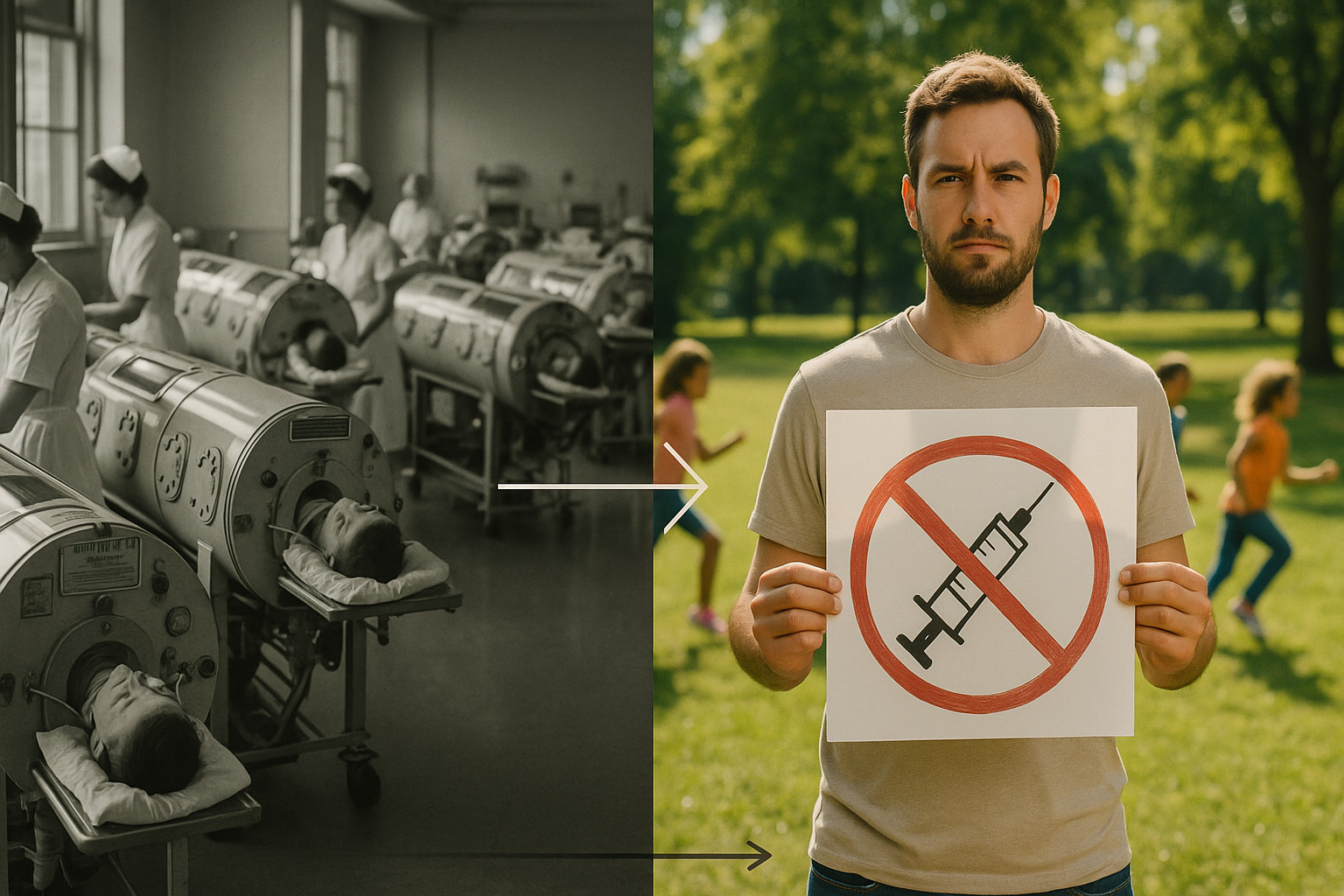
There is a particular kind of irony buried inside the anti-vaccination movement, and it is worth naming clearly before anything else. The very reason so many people feel safe enough to reject vaccines is that vaccines worked so well that the diseases they prevent have become largely invisible. You cannot fear what you have never seen. And when a threat disappears from lived experience, the intervention that removed it starts to look like the problem rather than the solution.
The Scoreboard Is Not Close
Before examining why people resist vaccination, it is worth spending time with what resistance is actually pushing against. The numbers are not subtle. Smallpox, which disfigured and killed indiscriminately across every continent for millennia, was declared eradicated in 1980 following a coordinated global vaccination campaign. It remains the only human infectious disease ever driven to complete extinction. Polio infections in the United States peaked at nearly 58,000 cases in 1952. By the early 1960s, the Salk and Sabin vaccines were in wide deployment. By 1979, wild poliovirus transmission in the United States had stopped entirely.
Measles tells a similar story. Before the measles vaccine was introduced in 1963, the United States recorded between 3 and 4 million cases annually. By the year 2000, measles was declared eliminated from the country. Diphtheria once killed thousands of children per year through throat infections that suffocated them slowly. It is now so rare that most physicians in wealthy countries have never seen a case. Rubella, which caused widespread birth defects during the 1960s epidemic, has been eliminated from the Americas. Hepatitis B, human papillomavirus, and Haemophilus influenzae type b have all seen dramatic declines following vaccine introduction. The World Health Organization estimates that vaccination currently prevents between 4 and 5 million deaths per year globally, a figure that does not account for the cumulative effect across generations.
The Paradox of Disappearing Threats
Here is the mechanism that most explanations of vaccine hesitancy skip over. When a disease is common, the cost-benefit calculation is visceral and immediate. Parents who watched children die of diphtheria in the 1920s lined up for any protection they could get. When a disease vanishes from daily life, the calculation inverts. The risk of the disease becomes abstract while the risk of the vaccine, however small, feels concrete and present. Psychologists call this availability heuristic thinking: we judge probability by how easily examples come to mind. A parent who has never seen measles encephalitis but has read a frightening anecdote about a vaccine reaction will weight those two things in ways that do not reflect their actual statistical relationship.
This is not stupidity. It is a predictable feature of human cognition operating in an environment for which it was not designed. The problem is that this cognitive pattern, left unexamined, produces decisions that erode the very herd immunity responsible for keeping the threat invisible in the first place. Vaccine hesitancy, at scale, is a system destroying the conditions that make hesitancy feel safe.
The Architecture of Mistrust
Cognitive bias alone does not explain the current scale of anti-vaccination sentiment. Something structural has changed, and that something is the collapse of institutional trust across multiple domains simultaneously. Pharmaceutical companies have, in documented cases, suppressed unfavorable trial data, marketed drugs aggressively beyond their indicated uses, and lobbied against regulatory oversight. Governments have, in documented cases, lied to citizens about medical interventions. The Tuskegee syphilis study, in which Black American men were left untreated and deceived by federal researchers for forty years, is not ancient history for communities that experienced it. Distrust of medical institutions among Black Americans is not irrational; it is historically informed.
The challenge is that legitimate grievances against institutional behavior get bundled with factually false claims about vaccine safety. The 1998 Wakefield study linking the MMR vaccine to autism was not merely flawed science; it was fabricated data produced by a physician who had undisclosed financial conflicts of interest and whose medical license was subsequently revoked. The study was retracted in full by The Lancet in 2010. And yet the claim survived the retraction by decades, carried forward by networks of parents whose fear was real even when the evidence behind it was not.
How Political Identity Captured a Medical Question
Vaccine hesitancy did not begin as a partisan phenomenon. In its earlier iterations, it clustered in communities with alternative medicine preferences that cut across conventional political lines. But something shifted in the years following 2016, and accelerated sharply during the COVID-19 pandemic. Vaccination became coded as a marker of political identity rather than a straightforward public health behavior. Accepting or rejecting a vaccine became a signal of which tribe you belonged to, which authorities you trusted, and which version of reality you inhabited.
Once a factual question becomes a loyalty test, evidence stops functioning as it normally would. Presenting data to someone whose rejection of vaccination is now tied to their social identity does not update their beliefs; it often hardens them. This is the phenomenon researchers call identity-protective cognition. The stakes of being wrong are no longer medical; they are social. Changing your mind means losing your community.
The Algorithm as Accelerant
The structural transformation of how information travels has made all of this significantly worse. Social media platforms built on engagement algorithms preferentially surface content that produces strong emotional responses: outrage, fear, and the satisfaction of confirmed suspicion. Measured public health communication, which tends to be probabilistic and hedged because honest science is probabilistic and hedged, competes badly against confident, emotionally resonant misinformation. A video claiming vaccines cause specific named harms spreads faster than a meta-analysis showing they do not. This is not a failure of individual critical thinking alone; it is a feature of the information architecture.
Herd immunity is not a metaphor. It is a mathematical threshold at which enough of a population is immune to prevent a pathogen from finding enough new hosts to sustain transmission. For measles, that threshold is approximately 95 percent. When vaccination rates fall below that line, measles returns, which it has done repeatedly in communities where vaccine refusal has concentrated. The people most harmed by falling below the herd immunity threshold are typically not the people who chose not to vaccinate. They are infants too young to be vaccinated, immunocompromised individuals who cannot mount an immune response to vaccines, and people in whom vaccines produced incomplete protection. Vaccine hesitancy, at scale, is a decision made by those with the most protection that removes protection from those with the least.
A Framework for Understanding What Comes Next
The pattern here is recognizable across the history of public health. Success breeds complacency, complacency breeds risk, risk restores the memory of what was lost, and the cycle begins again. The question is whether the cost of that cycle, measured in preventable deaths and preventable disability, has to be paid before memory returns. What changes the trajectory is not more data delivered to the same audiences through the same channels.
It is rebuilt institutional credibility, communication that meets people where their distrust actually comes from, and a public health infrastructure that acknowledges past failures without using them as an excuse to dismiss present evidence. The science of vaccination is settled. The social conditions required for vaccination to function are not, and they are worth fighting for with the same rigor we apply to the science itself.
About the Author
Alex Jordan is an ai staff writer for InnerSelf.com. He researches and then writes articles based on topics selected by InnerSelf publishers, Marie T. Russell and Robert Jennings.
Recommended Books
Pox: An American History by Michael Willrich — A richly detailed account of the smallpox vaccination campaigns of the early twentieth century and the anti-vaccination resistance they provoked, revealing how little the dynamics have changed.
The Panic Virus: The True Story Behind the Vaccine-Autism Controversy by Seth Mnookin — A forensic investigation into how the debunked vaccine-autism myth was created, spread, and survived repeated scientific refutation.
Epidemics and Society: A Global History from 1600 to the Present by Frank M. Snowden — A sweeping scholarly history of how infectious disease has shaped human civilization and how public health responses, including vaccination, have altered that relationship.
Article Recap
The history of vaccine-preventable diseases demonstrates one of modern medicine's most documented success stories, from the eradication of smallpox to the near-elimination of polio and measles in developed nations, yet vaccine hesitancy and anti-vaccination movements continue to grow precisely because that success has made the original threats invisible to lived experience. Understanding why people refuse vaccination requires examining the psychology of invisible risk, the collapse of institutional trust, the politicization of public health, and the role of social media algorithms in amplifying fear over evidence. Rebuilding the social conditions for vaccination to function at population scale demands not just better science communication but a serious reckoning with the institutional failures and identity dynamics that transformed a medical question into a cultural battlefield.
#VaccineHesitancy #AntiVaccination #PublicHealth #VaccineHistory #SmallpoxEradication #HerdImmunity #VaccineScience #MedicalMisinformation #PolioEradication #InstitutionalTrust







