







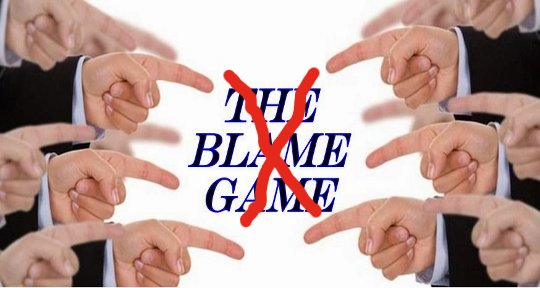
The Blame Syndrome negatively impacts relationships and personal well-being, manifesting in various forms from subtle gestures to outright accusations. By understanding the reasons behind blame and implementing effective strategies, individuals can learn to navigate conflicts without falling into destructive patterns, ultimately fostering healthier interactions and personal growth.
In This Article
- What is the Blame Syndrome and why does it matter?
- What are the functions of blame in human interactions?
- How can Positive Accountability help in overcoming blame?
- What practical steps can be taken to live Beyond Blame?
- What risks are associated with continuing to blame others?
The Blame Syndrome (the initial Blame Attack, the Emotional Impact and the Reactive Response) damages so many areas of life, and it needs to stop. Because blame can appear as everything from an arched eyebrow or a cynical sigh to a shouted accusation, identifying blame is not a simple task. And taking steps to eliminate it takes sustained effort. But it's well worth it.
The payoff of living Beyond Blame is immediate, tangible and permanent.
Time after time when I present the concepts in this book to my patients, I hear, "I grew up with so much blame in my family, if only my parents had been able to..." Or, "My first marriage was nothing but a blame-a-thon. If only we could have..." Or, "If the managers of my company could understand that criticizing and accusing doesn't help, we'd be so much more efficient!"
Why Do We Use Blame?
Let's start by reviewing the four functions of blame. We use blame:
- when we want to change another person's behaviors through criticism, accusation, punishment or humiliation;
- when we want to vent a feeling such as anxiety, anger, resentment, pain or fear;
- when we want to escape personal responsibility by shifting it onto someone else; or
- when we try to protect ourselves from being seen as wrong or bad.
Here's a step-by-step outline of the interventions necessary for living Beyond Blame. They're arranged in a sequence that won't fit every situation; there's just too much variation within human communications. So be ready to adapt them to your own situation, knowing that every major concept will show up somewhere in the process.
How To Deal With Blame
 What do you do when confronted with blame — when someone criticizes, accuses, punishes or humiliates you? How do you take care of yourself? How do you correct a mistake, or get someone to change a behavior? How do you express an emotion, or communicate your own personal needs, without falling into the trap of using blame?
FIRST STEP: Use Positive Accountability.
When you engage Positive Accountability, you practice two behaviors:
- Thoughtfully acknowledge an error, your own or another person's, and consider how to repair it, if necessary.
- Express an emotion, or a need, without using criticism, accusation, punishment or humiliation.
Find a way to express yourself without criticizing or accusing anyone. This demands thoughtful consideration, but it's the only way out of the thorny thicket of blame. And it requires careful, rigorous adherence to the second step:
SECOND STEP: Maintain a 4:1 ratio of thought to emotion.
That's 80 percent thinking to 20 percent feeling. This means that when your sweetheart does something incredibly inconsiderate and you're about to fly into a rage, don't make a move, don't do anything. Stop... and think about the most effective way to respond. You cannot allow powerful emotions to overwhelm your clear thinking.
THIRD STEP: Ask yourself the Question of Intention
The Question of Intention: "What do I want to accomplish right now, in this moment, with this interaction?" Take a few seconds to think about what you really need, what's in your best long-term interests. Clearly, it's to not humiliate the other person, or try to get even. Having a clear intention will help you not be overwhelmed by negative emotions.
FOURTH STEP: Remember the Law of Personal Limitations
The Law of Personal Limitations states that everyone's thinking and behavior is intrinsically limited and fallible. Here's the complete version:
Everyone is always doing as well as they can within their personal limitations, their personal history, what they know and don't know, and what they're feeling in that moment. If they could make a healthier decision, they would. This includes YOU.
Finally, there's:
FIFTH STEP: Engage the Law of Lessons Learned
The Law of Lessons Learned states: Every mistake contains a lesson. Make a note of the lesson, process the accompanying emotion, and move on with your life.
This law teaches us the necessity of extracting the lesson from the mistake or experience, writing it down to refer to in the future, then moving on. Taking the lesson to be learned and discarding the incident's details helps to stop brooding over what you could have/should have done. Most important: it eliminates guilt, the incessant self-criticism for a past mistake.
Navigating Through the Jagged Rocks of Shame
This five-step sequence provides a nautical chart to guide you through the jagged rocks that can sink relationships. Using these ethical, psychological, spiritual and practical structures, you have all you need to live completely Beyond Blame.
©2011 by Carl Alasko. All Rights Reserved.
Reprinted with permission of the publisher, Jeremy P. Tarcher/Penguin,
a member of Penguin Group (USA). www.us.PenguinGroup.com.
Article Source:
Beyond Blame: Freeing Yourself from the Most Toxic Form of Emotional Bullsh*t
by Carl Alasko, Ph.D. Carl Alasko reveals that the need to assign blame when something bad happens stems from a very deep desire we all share to "see justice done". Understandable when a grave crime has been committed, but it can become a dangerous habit if we begin to operate as though placing blame were somehow necessary if we want to change something or someone in our world. In Beyond Blame, the author teaches readers to recognize destruction that blame causes in their lives - oftentimes without their even being aware - and to put an end to it once and for all.
Click here for more info or to order this book. Also available as a Kindle edition.
About the Author
 Carl Alasko, Ph.D. has been a practicing psychotherapist specializing in couples and families for over twenty years. For the past thirteen years he has written a weekly advice column, "On Relationships", for the Monterey County Herald, which has consistently been one of the Herald's most popular columns. He has also given numerous lectures on the topic of healthy relationships and has hosted a popular advice radio show. Visit his website at www.carlalasko.com
Watch a video: Carl Alasko Talks about Emotional Bullshit
Further Reading
-
Beyond Blame: A New Way of Resolving Conflicts in Relationships
This book offers a practical path for moving out of accusation, defensiveness, and emotional reactivity. It helps readers understand how blame damages relationships and how accountability can become a healthier alternative to criticism or shame.
Amazon: https://www.amazon.com/exec/obidos/ASIN/0787902497/innerselfcom
-
Nonviolent Communication: A Language of Life: Life-Changing Tools for Healthy Relationships
Marshall B. Rosenberg presents a communication method built around clear observation, emotional honesty, needs, and respectful requests. It is especially useful for replacing blame with language that supports repair, empathy, and mutual understanding.
Amazon: https://www.amazon.com/exec/obidos/ASIN/189200528X/innerselfcom
-
The Anatomy of Peace, Fifth Edition: Resolving the Heart of Conflict
The Arbinger Institute examines how conflict often begins in the way we see ourselves and others. Its central value is helping readers shift from self-justification and blame toward responsibility, openness, and a more peaceful way of responding.
Amazon: https://www.amazon.com/exec/obidos/ASIN/B0DWZRZ835/innerselfcom
Article Recap
Recognizing and addressing the Blame Syndrome is crucial for healthier relationships. Implementing Positive Accountability and understanding personal limitations can pave the way for more constructive interactions.
#InnerSelfcom #BlameSyndrome #PositiveAccountability #EmotionalWellbeing #ConflictResolution #PersonalGrowth







