In This Article
- Why seven prime ministers in a decade signals something far deeper than bad luck
- How Britain went from running the world to struggling to run itself
- What the gutting of industrial communities has to do with the Brexit vote
- How decades of tabloid anti-Europe propaganda shaped a referendum
- Why Britain's story is a warning the United States should read carefully
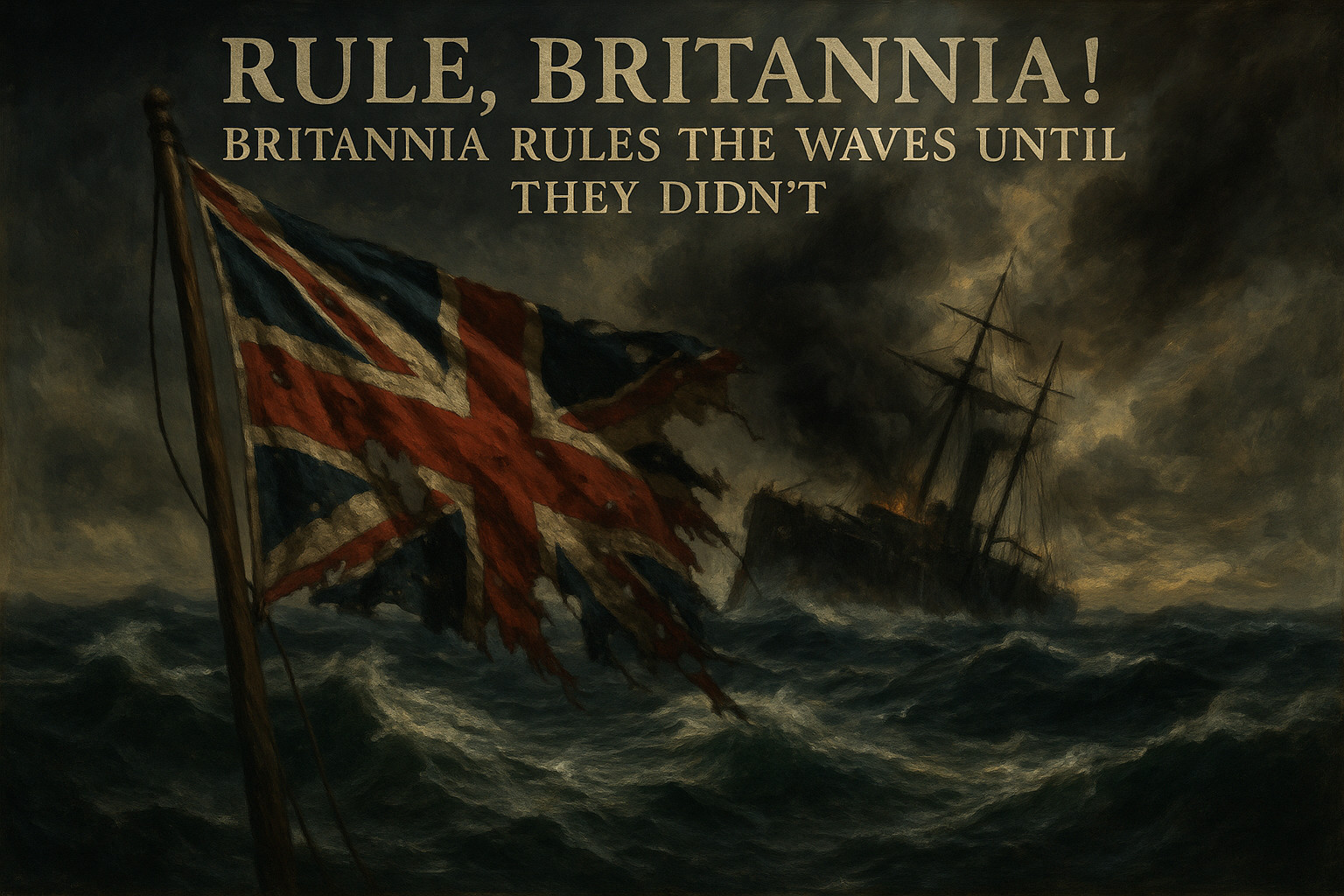
There is a particular kind of national delusion that only great powers can afford, and Britain has been running on it for a long time. It is the belief that past glory is a substitute for present strategy. That an empire which ended seventy years ago still counts as a personality. That being the nation that once ruled a quarter of the earth's surface means something when you are currently arguing about whether you can afford to fix the NHS. History is a fine thing to be proud of. It is a terrible thing to govern with.
Seven Prime Ministers and a Nation Losing Its Bearings
In the span of roughly ten years, Britain has cycled through seven prime ministers. David Cameron called a referendum to manage his own party and then resigned when it went wrong. Theresa May spent three years being devoured by the deal she could not deliver. Boris Johnson turned 10 Downing Street into a party venue during a pandemic lockdown and seemed surprised when people noticed. Liz Truss lasted forty-five days before the bond markets politely but firmly ended her experiment in fantasy economics. Rishi Sunak came in as the adult in the room and left as evidence that competence alone cannot fill a political vacuum. Keir Starmer arrived with a mandate built mostly on exhaustion with the previous lot, and has found governing a fractured country considerably harder than opposing one.
For comparison, think about what political stability used to look like on that island. Churchill and Attlee between them covered the postwar decade. Thatcher ran for eleven years. Blair ran for ten. Stability is not glamorous, but it allows a government to actually do things rather than spend all its energy surviving until Thursday. What Britain has now is not leadership succession. It is leadership consumption, and the country is being ground up in the process.
The instability is not the disease. It is the fever that tells you the disease is there. The underlying infection is a political class that has run out of honest answers to structural problems and has been substituting performance, blame, and nostalgia ever since.
When Britain Ruled the World
To understand the fall, you have to start with the height. At its peak, Britain ran the largest empire in human history. The Royal Navy was not merely the strongest fleet on the ocean. It was the ocean, effectively. London was the financial capital of the world, sterling was the global reserve currency, and British-built railways carried goods across continents that British merchants had opened up. The Industrial Revolution did not begin somewhere else and spread to Britain. It began in Britain and spread everywhere else.
This was not a small country that punched above its weight. This was the first genuinely global superpower, and it shaped the modern world in ways that are still visible in legal systems, languages, borders, and institutions on every continent. When people talk about the British Empire with reflexive pride, they are not entirely wrong that it was extraordinary. They are just sometimes confused about what extraordinary means. Extraordinary things include the engineering of the Suez Canal and the engineering of the Bengal famine. History tends to hand you both.
The point here is scale. Britain was not one of the great powers. For a period, it was the great power. What followed was always going to be a significant psychological adjustment. The question was whether the country would make that adjustment consciously and strategically, or drift into denial. The answer, as it turns out, was mostly the latter.
Winning the Wars and Losing the Peace
Britain won two world wars and emerged from both of them considerably poorer than it went in. The First World War left debts that were not fully paid off until 2015. The Second World War exhausted what remained of British industrial capacity and financial reserves, even as it produced the genuine heroism that British culture has been dining out on ever since. Victory, it turns out, can be almost as ruinous as defeat if the cost is high enough.
India left in 1947 and the empire followed, piece by piece, over the next two decades. The Suez Crisis of 1956 was the moment the new reality became impossible to ignore. Britain and France attempted to retake the Suez Canal after Egypt nationalized it, and the United States told them to stop. They stopped. The lesson was clear: the British lion still had a magnificent roar, but the Americans now held the leash, and everyone knew it.
The rise of the United States reshuffled the global deck entirely. Britain went from being the senior partner in the Atlantic alliance to being the reliable, slightly older friend who still gets invited to the good meetings but does not set the agenda. This is a perfectly workable position for a mid-sized European power. The trouble was that significant portions of the British political class, and a significant portion of the public, never entirely accepted the mid-sized European power description. That gap between self-image and reality has caused an enormous amount of mischief.
From Making Things to Moving Money
The communities that built Britain's industrial greatness did not simply evolve into something else when the factories closed. They were left behind while the country's economic identity quietly relocated to a square mile in London. Coal mining collapsed. Steel mills shut. Shipbuilding, which once made Britain the workshop of the world's navies, largely disappeared. Manufacturing moved to wherever labor was cheaper, which turned out to be almost anywhere.
The City of London grew to fill the economic space that industry left behind. Financial services, insurance, currency trading, legal services, and consultancy became the engine of the British economy. This was enormously profitable for the people who worked in it and for the government that taxed it. It was rather less useful for the man in Middlesbrough whose father worked in steel and whose son cannot find stable work of any kind.
The honest accounting of this transition is uncomfortable. Deindustrialization created real wealth in the aggregate while destroying specific communities in detail. The aggregate showed up in GDP figures and ministerial speeches. The detail showed up in addiction rates, life expectancy gaps, and voting patterns that would eventually shock the people who had never visited those places. You can run an economy on finance, but you cannot run a society on it, and Britain spent thirty years trying to figure out why the two things were not the same.
The Two Britains and the Seeds of Brexit
London and the southeast of England have, by most measures, done reasonably well over the past four decades. House prices that would make a Manhattan real estate agent briefly envious. A concentration of investment, infrastructure, and opportunity that has no equivalent anywhere else in the country. International talent flowing in from everywhere. A restaurant scene of genuine world quality.
Meanwhile, in the former industrial heartlands of the north, the Midlands, and Wales, the picture has been considerably different. Regional investment has consistently tilted south. Transport infrastructure in much of the north would embarrass a country a fraction of Britain's wealth. The housing affordability crisis that afflicts London exists for different reasons in these places: not because prices are too high, but because wages are too low and stable employment is too scarce.
This is not an accident. It is the predictable result of policy choices made over decades about where to invest and whose economic pain was an acceptable cost of progress. The resentment that built up in those communities was genuine and earned. When a referendum came along that offered those communities a chance to register that resentment in a form that could not be ignored, a great many of them took it. You can call that decision strategically unwise. You cannot honestly call it irrational.
Murdoch, the Tabloids, and Thirty Years of Anti-Europe Stories
The Brexit vote did not come from nowhere. It came from thirty years of newspaper front pages that treated Brussels as a foreign occupying power, European regulations as an assault on British dignity, and any politician who suggested that European cooperation might be in Britain's interest as a traitor to the nation. This campaign was not spontaneous. It was organized, funded, and relentlessly sustained by a small number of newspaper proprietors, of whom Rupert Murdoch was by far the most consequential.
The Sun, the News of the World before its collapse, and the Daily Mail ran anti-EU stories so regularly and with such inventive disregard for factual precision that they became a kind of background noise in British political life. Bent bananas. Metric martyrs. Faceless eurocrats telling British farmers what to do. Some of these stories were true in the way that a caricature is true: there is something in there that resembles reality, but the distortion is the whole point. The cumulative effect, over decades, was to build a political culture in which European membership was seen as something Britain tolerated rather than something Britain chose.
The slogan "Take Back Control" was not invented in 2016. The emotional pitch behind it had been rehearsed on tabloid front pages since the 1990s. By the time the referendum arrived, Nigel Farage and the Leave campaign did not have to build an argument from scratch. They had an argument that had been pre-installed in millions of British minds over thirty years of daily repetition. That is not persuasion. That is conditioning.
Russia Finds a Ready Audience
It would be convenient to blame Brexit entirely on foreign interference, and some people have tried. The reality is more complicated and, in some ways, more disturbing. Russian social media operations, troll farms, and online influence campaigns were real. They targeted British voters with content designed to inflame existing divisions, amplify distrust of institutions, and push people toward the more disruptive option available. This is documented and not seriously disputed.
But Russia did not create the divisions it exploited. The inequality was real. The resentment in post-industrial communities was real. The decades of tabloid conditioning were real. What the Russian operations did was find a wound that was already there and press on it. They were not surgeons performing an operation. They were opportunists with a thumb.
The distinction matters because it tells you something about vulnerability. A society with functional institutions, broadly shared prosperity, and a media ecosystem oriented toward accuracy is significantly harder to manipulate. Britain in 2016 was none of those things. That is the lesson. Not that the Russians are uniquely clever, but that a fragmented, unequal, and misinformation-saturated society is an open invitation to anyone who wants to make things worse.
Brexit and the Bill That Came Due
Brexit was sold as liberation. What it delivered was paperwork, trade friction, reduced labor mobility, and a steady drip of investment decisions that went to Dublin, Amsterdam, or Frankfurt instead of London. Financial firms did not all leave overnight, which the Leave campaign cited as evidence that the warnings had been wrong. They left gradually, which is considerably worse because it does not produce a single dramatic headline, just a slow erosion that is hard to photograph.
The fishing industry that featured so prominently in the Leave campaign's imagery turned out to receive a deal that most actual fishermen considered inadequate. The bonfire of EU regulations that was promised has not materialized in any meaningful way, because most of those regulations existed for reasons that did not disappear when Britain left. The sovereignty that was reclaimed has been exercised primarily to demonstrate that Britain can make its own mistakes without requiring permission from Brussels first.
None of this means that every concern behind the Brexit vote was wrong or that the European Union is beyond criticism. The EU is a bureaucratic, frequently frustrating, and imperfectly democratic institution. It is also, by most available measures, considerably better for trade, investment, and geopolitical influence than the alternative Britain chose. Pointing this out is not unpatriotic. It is arithmetic.
Britain's Warning to America
The British story is worth telling not because Britain is uniquely foolish, but because it got there first. The Murdoch media machine that spent thirty years preparing Britain for Brexit is the same enterprise that has spent decades shaping American political culture through Fox News. The inequality between coastal prosperity and heartland decline that powered the Leave vote has a precise American analogue. The distrust of institutions, the nostalgia politics, the leaders who offer cultural grievance as a substitute for economic policy: these are not peculiarly British afflictions. They are symptoms of a broader democratic stress fracture, and Britain simply cracked first.
America has the advantage of watching what happened. Whether it has the wisdom to learn from it is a separate question. The mechanisms are identical: decades of concentrated media narrative, growing inequality distributed in ways that leave specific communities feeling invisible, political entrepreneurs who find it easier to channel resentment than to solve the problems producing it, and foreign actors who did not create the kindling but are happy to strike matches. Britain did not become irrelevant because its people are foolish. It became irrelevant because its institutions were weakened, its inequalities were ignored, and its media landscape rewarded outrage over accuracy, long enough and thoroughly enough that when the decisive moment came, the country chose the story it had been told over the reality it could see.
The story writes itself: you do not fall from greatness all at once; you talk yourself down, one headline at a time.
About the Author
 Robert Jennings is the co-publisher of InnerSelf.com, a platform dedicated to empowering individuals and fostering a more connected, equitable world. A veteran of the U.S. Marine Corps and the U.S. Army, Robert draws on diverse life experience, from real estate and construction to building InnerSelf.com with his wife, Marie T. Russell, bringing a practical, grounded perspective to life's challenges. InnerSelf grew from InnerSelf Magazine, founded by Marie T. Russell in 1985, which became InnerSelf.com in 1996. Decades later, InnerSelf continues to inspire clarity and empowerment.
This article is licensed under a Creative Commons Attribution-NonCommercial-NoDerivatives 4.0 License. You may share it with attribution to Robert Jennings, InnerSelf.com, and a link back to the original article at InnerSelf.com. Commercial use and derivative works are not permitted without permission.
Recommended Books
This Is Not Normal: The Collapse of Liberal Britain by William Davies — A sharp and unsettling examination of how British political and cultural institutions eroded in the years surrounding Brexit.
Inglorious Empire: What the British Did to India by Shashi Tharoor — A rigorous and often devastating account of the human and economic costs of British imperial rule that complicates easy nostalgia.
The Road to Somewhere: The Populist Revolt and the Future of Politics by David Goodhart — An honest attempt to understand the values divide between globalized elites and rooted communities that made Brexit and similar movements possible.
Article Recap
Britain's long decline from global superpower to politically unstable middle power is the result of unaddressed deindustrialization, decades of anti-European tabloid narratives, and a widening inequality between London and the post-industrial regions that fueled the Brexit vote. Understanding how great power decline happens through institutional erosion, media manipulation, and short-term political thinking offers essential lessons for any democracy that assumes its stability is self-sustaining. The warning Britain sends to America and other Western nations is not that decline is inevitable but that it is invisible until it is not, and by then the cost of course correction has grown very high.
#BritishDecline #BrexitConsequences #UKPolitics #PostIndustrialBritain #MediaManipulation #PoliticalInstability #RussianInterference #InequalityInBritain #WarningToAmerica #DemocracyInCrisis