







In This Article
- Why democracy existed long before the Greeks gave it a name
- How tribal councils and village assemblies solved the same problems we still face today
- Why Rome fell and what that pattern tells us about our own moment
- What the Magna Carta actually was — and what people get wrong about it
- Why concentrated wealth is the oldest enemy democracy has ever faced
Most of us were taught that democracy started in ancient Greece, got a boost from a muddy field in England in 1215, and then climbed steadily upward until it arrived, finished and polished, on our doorstep. That version of history is clean and comforting. It is also wrong. The real story is messier, older, and far more instructive — because it turns out that every generation, in every corner of the world, has faced exactly the same problem: power tends to concentrate, and concentrated power tends to abuse. The question was never whether democracy was a good idea. The question was always who had the nerve to defend it.
The Oldest Political Instinct in the World
Before there were kings, there were groups of people trying to survive winters. Anthropologists who study hunter-gatherer societies keep finding the same thing: these groups were not ruled by the strongest individual in the way popular imagination tends to picture. A man who hoarded meat or made decisions for everyone else without consent did not last long. The group had ways of handling him, ranging from ridicule to exile to outcomes that no one put in writing.
This was not democracy as a philosophy. It was democracy as a survival mechanism. Small groups could not afford a tyrant. If one person controlled all the food, made all the calls, and could not be questioned, the group died. So informal systems of accountability emerged — not because people were idealistic but because they were practical. The instinct for participation may be the oldest political instinct human beings have.
Indigenous governance traditions around the world reflect this pattern. Tribal councils, decision-making by consensus among elders, the expectation that leaders speak for the group rather than over it — these are not primitive approximations of democracy. In many cases they are sophisticated expressions of the same core principle that every democratic system has tried to formalize: no single person should hold unchecked power over everyone else.
When Settlements Grew and Informal Consensus Got Complicated
The agricultural revolution changed the math. Once people stopped moving and started growing crops, populations grew, surpluses accumulated, and the question of who controlled those surpluses became urgent. Informal consensus works beautifully in a group of thirty people. It gets unwieldy in a settlement of three thousand.
This is where village assemblies, councils of elders, and early legal traditions came from. They were attempts to preserve the spirit of collective decision-making while scaling it up to fit larger communities. Mesopotamian city-states had councils alongside their kings. Early Germanic peoples held assemblies called things, where free men gathered to make laws and settle disputes. Indigenous confederacies in North America developed governance structures so sophisticated that some historians argue they directly influenced the framers of the American Constitution.
The challenge in every case was the same one we still argue about: how do you organize a large society without letting whoever sits at the top accumulate so much power that accountability becomes a formality? People have been working on that problem for thousands of years. Nobody has solved it permanently yet.
Athens and the First Big Democratic Experiment
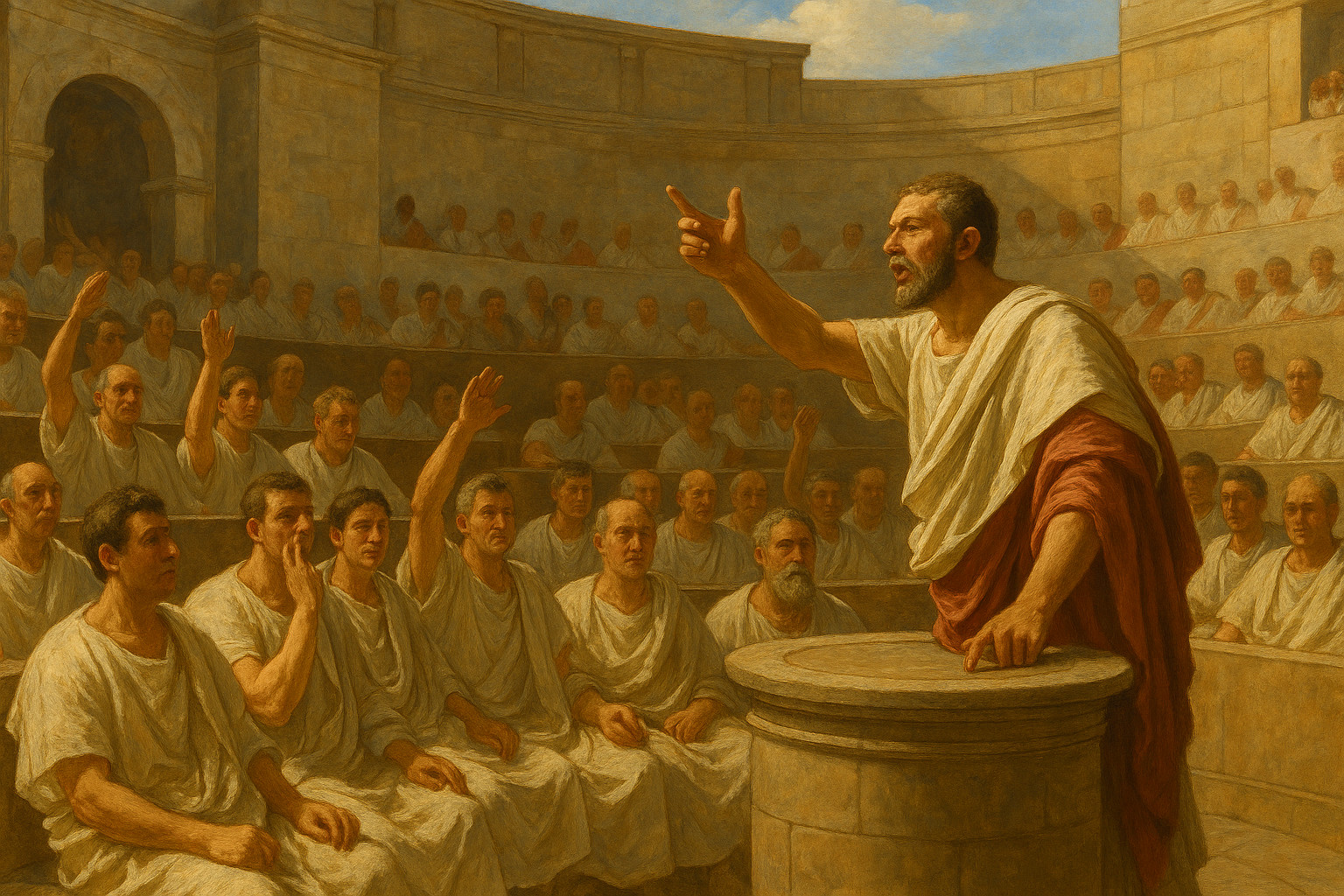
The Athenians deserve credit for scaling participation into a formal system. The citizen assembly, the public debates, the principle that ordinary men could vote and hold office — these were genuinely revolutionary ideas for their time. Athens looked at the question of who should govern and said, essentially, all of us.
And then they drew the list of who counted as all of us and left out women, enslaved people, and anyone born outside the city. Which means Athenian democracy was, by our standards, a democracy for a fairly small slice of the actual population. This is not a small asterisk. It is a reminder that every expansion of democracy in history has involved someone fighting to be included on a list that previous generations considered complete. Athens was not a destination. It was a prototype.
What Athens proved was that the idea worked at scale. Ordinary citizens could debate, decide, and govern. The city did not collapse. Public life did not descend into chaos simply because a farmer had the same vote as a wealthy merchant. That was a genuinely new piece of evidence in the world, and it mattered enormously for every democratic experiment that followed.
Rome and the Warning Nobody Wanted to Hear
Rome took the democratic inheritance from Greece and built something more durable: a republic with representative institutions, separation of powers, legal traditions, and the idea that even the most powerful officials were accountable to something larger than themselves. For a few centuries, it functioned. Then wealth began to concentrate. The Senate became a club for the extremely rich. Laws were adjusted to benefit those who could afford the adjustment. The institutions remained but the accountability drained out of them.
What killed the Roman Republic was not an invasion from outside. It was the oldest pattern in political history: economic inequality hollowed out democratic norms until the forms survived but the substance was gone. By the time Julius Caesar crossed the Rubicon, most Romans had already stopped believing that the Senate represented them. Caesar was not the cause of the Republic's death. He was the symptom.
This pattern has repeated itself with remarkable consistency across history. Democratic institutions do not usually fail because someone kicks the door down. They fail because concentrated wealth gradually purchases influence, influence gradually captures institutions, and institutions gradually stop doing the thing they were built to do. The Romans lived through that story. So did the Athenians. The question worth sitting with is whether we recognize the story while we are still inside it.
The Magna Carta and the Idea That Changed Everything
The Magna Carta was not a democratic document. Let us get that straight before the mythology takes over. It was a deal struck between an extremely unpopular king and a group of barons who were tired of being robbed. The people it protected most directly were wealthy landowners, not peasants. It did not establish universal rights. It did not create a parliament. It was, in the most literal sense, an agreement among elites.
And yet it planted something that would outlive everyone in that field at Runnymede in 1215. The principle that a ruler is subject to law — not above it, not the source of it, but bound by it — was a crack in a very old foundation. Kings had ruled by divine right, by force, by inheritance. The idea that a piece of parchment could constrain a king was not just practical. It was philosophical dynamite.
What followed over the next several centuries was slow, contested, and frequently violent. Parliament grew. Legal institutions strengthened. The English Civil War killed a king. The Glorious Revolution replaced another. Constitutional monarchy replaced absolute monarchy. None of it happened smoothly or charitably. Every expansion of limits on power was extracted from those who held power by people willing to fight for it. That is how it has always worked.
Revolutions and the Explosive Expansion of Democratic Ideas
By the time the Enlightenment had finished making its arguments, the intellectual case for democracy was overwhelming. Natural rights, consent of the governed, the idea that political authority derives from the people rather than from God or bloodline — these were not just philosophical propositions. They were challenges to every existing government on earth.
The American and French Revolutions turned those ideas into governing documents. Popular sovereignty stopped being a theory and became a constitutional principle. The democratic vision expanded dramatically in the space of a few decades. It was genuinely thrilling, and genuinely incomplete. The men who wrote that all men are created equal owned enslaved people. The constitutions that guaranteed rights excluded women, the poor, and everyone without property. The Enlightenment ideals were real. So were the contradictions. Holding both of those things at once is not cynicism — it is accuracy.
The importance of those revolutions is not that they completed democracy. It is that they dramatically raised the stakes. Once a government officially rests on the consent of the governed, every exclusion from that consent becomes a visible injustice with a clear legal argument against it. The contradictions became the engine for every democratic expansion that followed.
Industrial Wealth and the Familiar Return of Concentrated Power
Here is where the story loops back in a way that should feel uncomfortably recognizable. The Industrial Revolution created concentrations of private wealth that rivaled the power of governments. The robber barons of the nineteenth century did not sit on thrones or command armies in the old sense. They did not need to. They owned the railroads, the steel mills, the newspapers, and eventually the politicians. The mechanism of control had changed. The result was familiar.
Kings no longer held absolute power. Economic elites often exercised something comparable. A senator who relies on industrial donations to get elected and keep his seat is not, in the functional sense, an independent representative of the people. He is something closer to a contractor with a complicated client relationship. The form of democracy survived. The accountability question became urgent again.
Labor movements, antitrust laws, progressive taxation, and social safety nets were all attempts to answer the same question the barons at Runnymede were asking: how do we prevent power from becoming so concentrated that the official rules stop applying to the people who hold it? The Industrial Age did not create a new problem. It created a new version of the oldest problem, wearing a three-piece suit instead of a crown.
Why Every Democracy Tends to Drift Toward Oligarchy
There is a pattern here that deserves to be named plainly. Democracies, left unattended, tend to drift toward oligarchy. Wealth concentrates. Concentrated wealth buys influence. Influence shapes legislation, regulatory agencies, media, and the flow of information. Over time, the people who benefit most from existing arrangements gain the most power over those arrangements. This is not a conspiracy theory. It is a description of gravity.
Rome did it. Medieval Europe did it. Industrial America did it. The question for any democracy is not whether this drift is possible but whether the society has the political will to resist it. Antitrust action, campaign finance limits, independent judiciary, free press, strong labor — these are not abstract goods. They are the specific mechanisms that push back against a specific force. When those mechanisms weaken, the drift accelerates.
Today the concentration of power runs through digital monopolies, global financial systems, and the control of information at a scale that has no historical precedent. A handful of technology platforms now mediate the political conversations of billions of people. That is a form of influence that no king, baron, or industrial magnate ever had access to. The old tools for limiting power may not be scaled for what we are currently facing.
What the Next Magna Carta Might Look Like
Every age has had to invent its own safeguards against the specific concentrations of power that age produced. The barons at Runnymede were not worried about social media algorithms. The framers of the American Constitution were not thinking about trillion-dollar technology companies. They were addressing the threats they could see. The job of each generation is to see the threats of its own moment clearly enough to build new limits around them.
What that looks like today is genuinely contested, and the argument is worth having rather than avoiding. Corporate concentration in media, finance, agriculture, technology, and pharmaceutical industries raises questions about whether markets are actually competitive or whether a small number of actors have captured them. Artificial intelligence concentrates the power to shape information, make consequential decisions, and surveil populations in ways that democratic accountability has not yet caught up with. Global financial flows move faster than any regulatory body can track.
The historical record is unambiguous on one point: concentrated power does not voluntarily distribute itself. Every meaningful limit on power in the last thousand years of democratic development was fought for, usually against the determined opposition of whoever held that power at the time. The barons did not get the Magna Carta because King John had an enlightened afternoon. They got it because they showed up armed. That is not a call to violence. It is a description of how change has actually worked, so that no one is surprised when the people holding concentrated power today do not simply hand it back out of civic virtue.
Democracy Is Not a Monument It Is a Practice
The most dangerous idea about democracy is that it is something you inherit and maintain, like a house with good bones that mostly takes care of itself. It does not. Every democratic institution that exists today was built by people who chose to build it, against opposition from people who preferred the arrangement that existed before. Every expansion of rights was extracted. Every limit on power was contested.
The long view of history does not produce optimism or pessimism about democracy. It produces something more useful: realism. Democratic systems have shown extraordinary resilience when people treat them as ongoing commitments rather than finished products. They have collapsed with disturbing speed when people assumed they were permanent. Athens fell. The Roman Republic fell. Democracies in the twentieth century fell to authoritarians who were, in many cases, invited in by populations that had grown tired of the argument.
The argument is the point. The continuous, contentious, sometimes maddening argument about who holds power and who limits it and who gets included in the decision — that argument is not a sign that democracy is broken. It is the sign that democracy is still alive. The moment that argument stops is the moment to start worrying. History suggests the answer to every generation's version of this question is the same: stay in the argument, know the mechanisms of power, and do not let anyone convince you the work is finished.
About the Author
 Robert Jennings is the co-publisher of InnerSelf.com, a platform dedicated to empowering individuals and fostering a more connected, equitable world. A veteran of the U.S. Marine Corps and the U.S. Army, Robert draws on diverse life experience, from real estate and construction to building InnerSelf.com with his wife, Marie T. Russell, bringing a practical, grounded perspective to life's challenges. InnerSelf grew from InnerSelf Magazine, founded by Marie T. Russell in 1985, which became InnerSelf.com in 1996. Decades later, InnerSelf continues to inspire clarity and empowerment.
This article is licensed under a Creative Commons Attribution-NonCommercial-NoDerivatives 4.0 License. You may share it with attribution to Robert Jennings, InnerSelf.com, and a link back to the original article at InnerSelf.com. Commercial use and derivative works are not permitted without permission.
Recommended Books
Democracy for Realists by Christopher Achen and Larry Bartels — A rigorous and unsentimental examination of how democratic theory collides with the actual behavior of voters and institutions.
The Wealth of Nations by Adam Smith — The foundational text on how economic power organizes itself and why its relationship to political freedom is perpetually unstable.
Twilight of Democracy by Anne Applebaum — A sharp and personal account of how democratic norms erode from within when elites choose loyalty to power over commitment to accountability.
Article Recap
The long history of democracy and concentrated power reveals that the struggle between self-governance and elite control is not a modern invention but humanity\'s oldest political conflict, stretching from hunter-gatherer tribal councils to Athenian assemblies to the Magna Carta and into the digital age. Understanding the historical pattern of democratic erosion and oligarchic drift is essential for anyone asking how democratic institutions survive concentrated wealth and information control in the twenty-first century. Each generation that has successfully defended shared decision-making did so not because the institutions were strong enough to protect themselves, but because enough people understood the mechanisms of power and chose to contest them.
#DemocracyHistory #ConcentratedPower #MagnaCarta #TribalDemocracy #PoliticalHistory #OligarchyVsDemocracy #HistoryOfGovernment #DemocraticErosion #PowerAndPolitics #CivicEngagement







