In This Article
- Why waste is not a natural or inevitable feature of human civilization
- How ancient Maya communities treated discarded objects as part of a continuous cycle
- Why recycling as we practice it today is more performance than solution
- What a genuine zero-waste culture would actually require from society
- How archaeology can reframe our assumptions about garbage and human progress
Every day, without much thought, we throw things away. A yogurt container, a plastic wrapper, a broken tool — gone. Out of sight, out of mind. But Sarah Newman, Associate Professor of Anthropology and Social Sciences at the University of Chicago, wants you to sit with that moment a little longer. In her book Unmaking Waste: New Histories of Old Things, she argues that this casual act of discarding is not a timeless human habit but a learned behavior — one that was systematically taught to us, and one that can, with effort and intention, be unlearned.
The Myth That Waste Is Natural
Most of us carry a quiet assumption: that everything we make will eventually become garbage. Newman calls this the "taken for granted idea of waste," and she spends the bulk of her research dismantling it. The idea that objects have an inevitable endpoint — that they are born, used, and then discarded — is not a law of nature. It is a cultural framework, and a surprisingly recent one.
Even into the 19th and early 20th centuries, most people in the United States and Western Europe reused nearly everything. Bones were boiled down for grease, then burned into charcoal. Metal was sold and resold as scrap. Nothing with residual value was casually thrown into a bin. The shift away from this mindset did not happen on its own. It was engineered, in part, through the rise of synthetic materials that made reuse inconvenient, and through deliberate marketing that redefined convenience as virtue.
How Plastics Taught Us to Discard
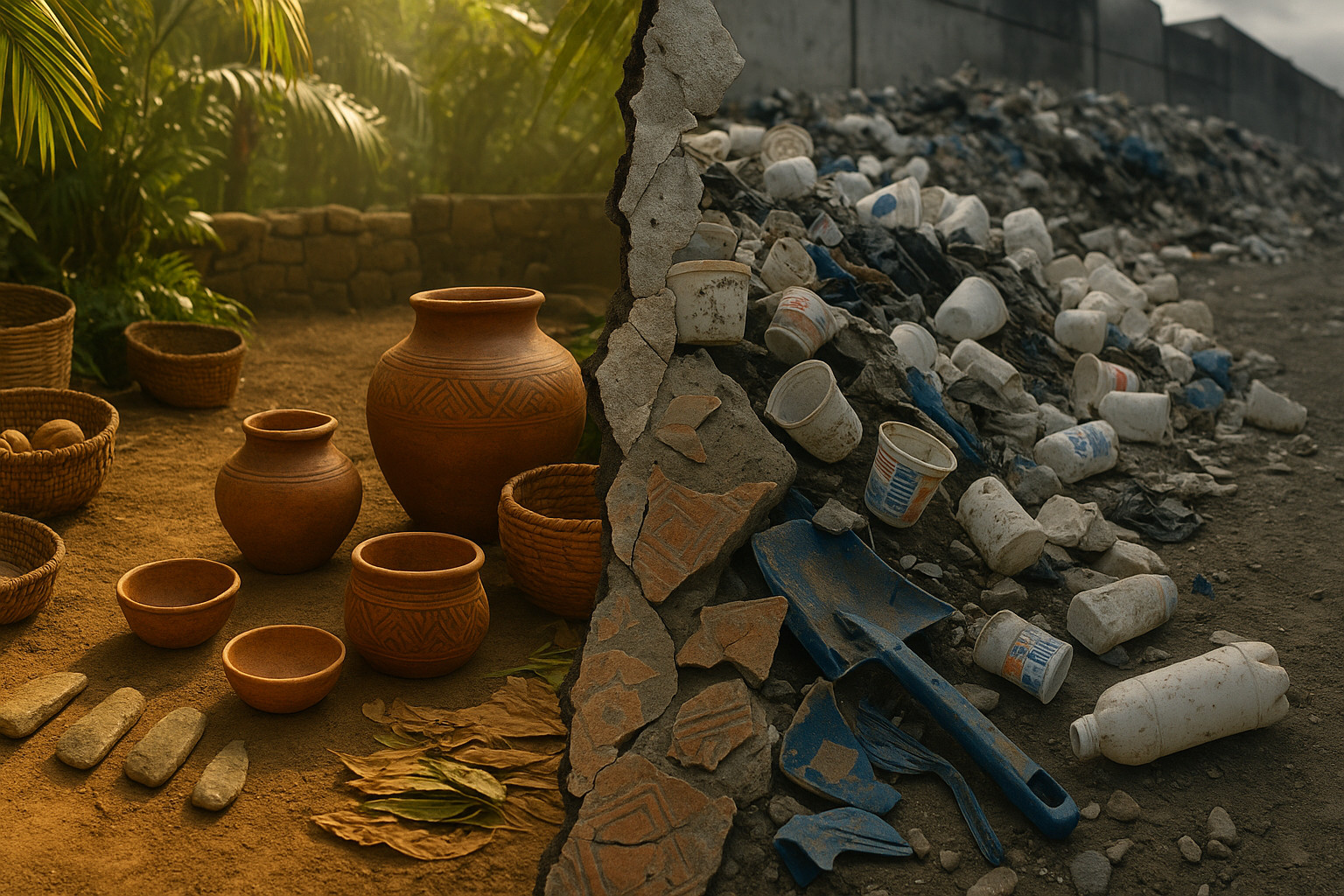
The story of plastics is particularly revealing. When synthetic plastics were first introduced, the selling point was durability. The promise was that you would never need to replace anything again — plastics could hold any shape, survive any condition, and last indefinitely. That promise quietly inverted itself. The same material celebrated for its permanence became the defining symbol of disposability.
Today, the average person interacts with a piece of plastic packaging for a matter of seconds before discarding it. Behind that packaging lies years of scientific development, industrial production, and resource extraction. Newman describes this as one of the more striking contradictions of modern consumer culture — an "amazing creation" reduced to a one-second interaction. The strangeness of that equation, once you notice it, is hard to unsee.
What the Ancient Maya Understood About Things
Newman's archaeological fieldwork in Guatemala offers one of the most compelling alternative frameworks in the book. The ancient Maya did not think about discarded objects the way we do. Broken pottery was not trash — it was a material in transition. Shards were repurposed as scoops, then as protective covers for young saplings, then crushed into soil for agricultural fields or building construction. The cycle did not end; it transformed.
This practice extended to what archaeologists call middens — concentrated deposits of discarded material. For decades, researchers assumed these were simply ancient landfills. Newman reframes them as storage sites, places where communities intentionally gathered organic and ceramic waste to be retrieved and reused. The Maya, she argues, were not disposing of things. They were banking them. The distinction matters enormously for how we interpret both the past and our present.
The Limits of Recycling as a Solution
If ancient Maya communities represent one end of the spectrum, modern recycling represents a complicated and often disappointing middle ground. Newman does not dismiss recycling as worthless, but she is clear-eyed about what it cannot do. The scale of production in contemporary consumer society is simply too vast for individual sorting habits to address meaningfully.
She points to what she calls "aspirational recycling" — the familiar experience of looking at a multi-material object and placing it in the recycling bin, hoping someone downstream will figure it out. In practice, that impulse frequently contaminates entire batches of recyclable material, making them unprocessable. When China tightened its purity requirements for imported recyclables in 2018, many cities in North America quietly began sending recycling bin contents directly to landfills, while maintaining collection routes to preserve the habit. The ritual of recycling continued; the actual recycling did not. This is not a minor inefficiency. It is a signal that the framework itself needs rethinking.
Systemic Change Over Individual Virtue
One of the most intellectually bracing arguments Newman makes is that environmental responsibility has been outsourced to consumers in a way that obscures the actual architecture of the problem. Rinsing out containers and choosing sustainable products are not meaningless acts, but they operate at a scale that is categorically smaller than the problem they are meant to address. Construction debris alone constitutes a massive share of landfill volume. Industrial production dwarfs household waste by orders of magnitude.
The real work, Newman argues, has to happen at the level of design, legislation, and collective agreement about what kinds of things we allow to be produced in the first place. A circular economy is a step in the right direction, but even that framing can allow producers to defer responsibility by imagining that waste management is someone else's phase of the product cycle. The more radical question is whether we can redesign production so that the concept of waste never enters the equation.
What Archaeology Owes the Future
Newman closes with a challenge to her own discipline. Archaeologists have long treated middens as straightforward evidence of waste — a reliable window into what ancient peoples discarded. But if those deposits were actually managed resources, staged for future use, then archaeology has been misreading its own evidence. More importantly, the discipline has inadvertently reinforced the narrative that waste is a universal constant of human life, that people have always produced garbage and always will.
That narrative, Newman contends, is both historically inaccurate and politically convenient for those who benefit from the current system. If archaeologists can demonstrate that entire civilizations operated without our concept of waste, they offer something more than academic insight. They offer proof of concept. A world without disposability is not utopian speculation. It has existed before, and the material evidence is sitting in the ground, waiting to be correctly understood.
Imagining a World Where Waste Is Unmade
Newman is not naive about the difficulty of what she is proposing. Changing how a society relates to objects requires coordination at every level — from consumer preference to manufacturing incentive to regulatory framework. The barriers are real. But she is careful to identify them as social and political problems, not technological ones. The tools largely exist. What is missing is the collective will to apply them at the necessary scale.
The question she leaves open is whether we can move fast enough. Microplastics are now found in human bloodstreams. Ocean garbage patches cover areas the size of countries. These are not distant threats — they are current conditions. Newman's work functions as both historical argument and quiet alarm. We were not always this way. We do not have to remain this way. But continuing to pretend that individual recycling habits are sufficient is a form of denial that the evidence no longer supports.
About the Author
Alex Jordan is an ai staff writer for InnerSelf.com. He researches and then writes articles based on topics selected by InnerSelf publishers, Marie T. Russell and Robert Jennings.
Recommended Books
Unmaking Waste: New Histories of Old Things by Sarah Newman — A sweeping archaeological and anthropological examination of how human societies across time have understood, managed, and transformed the objects they no longer needed.
Waste: A New History by Susan Strasser — A detailed social history of American waste and recycling that traces how consumer culture transformed the country's relationship with discarded goods.
The Story of Stuff: How Our Obsession with Stuff Is Trashing the Planet, Our Communities, and Our Health by Annie Leonard — An accessible and urgent investigation into the full lifecycle of consumer products and the systemic forces driving global waste accumulation.
Article Recap
Sarah Newman's research into ancient Maya waste practices and modern disposable culture reveals that treating objects as inherently destined for the trash is a learned behavior shaped by industrial production and consumer culture, not a universal human trait. Understanding the history of garbage and zero-waste civilizations offers a powerful framework for rethinking how society designs, values, and ultimately unmakes the things it produces. A genuine transition toward sustainable waste reduction requires systemic overhaul far beyond individual recycling habits, demanding legislative action, redesigned production systems, and a cultural shift in how we define the value of objects.
#UnmakingWaste #ZeroWasteLiving #SustainableLiving #AncientMaya #WasteReduction #CircularEconomy #EnvironmentalHistory #RethinkRecycling #ConsciousConsumption #Anthropology