







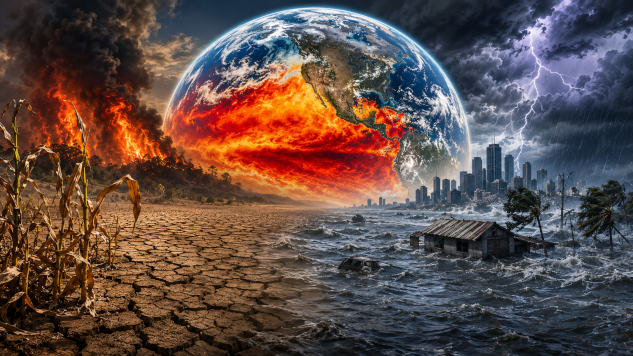
A super El Nino is building in the Pacific. James Hansen projects global temperatures could reach 1.7°C above preindustrial levels by 2027. The Iran war has already pushed fertilizer prices up 50 percent. Droughts and floods are battering the world's growing regions. The buffer stocks are thin. The insurance industry is retreating. And most governments are pretending this is temporary weather. Welcome to the oh-shit moment nobody prepared for.
In This Article
- What makes the 2026–27 El Nino potentially more dangerous than 1997–98
- Why James Hansen is predicting a global temperature record in 2027
- How the Iran war turned a climate risk into a full-blown food emergency
- Which regions face the gravest crop failures and hunger crises
- Why the insurance industry's retreat is the canary in the coal mine
- What compound disasters mean for a civilization built on efficiency rather than resilience
- Whether humanity can still build something better from the wreckage of old assumptions
The oceans are running a fever that has no modern precedent. The twelve-month period ending March 2026 was the warmest ever recorded anywhere on the planet's measurable surface. James Hansen, the NASA scientist who first warned Congress about climate change back in 1988, published a paper just weeks ago calling what is now developing in the Pacific a potential "Super-Duper El Nino." His Columbia University team projects that global temperatures could reach 1.7°C above preindustrial levels by 2027. That would shatter the Paris Agreement's 1.5°C target not as a future projection but as a measured fact.
At the same time, a war in Iran has severed the Strait of Hormuz — that narrow passage through which roughly one-third of the world's seaborne fertilizer trade normally flows. Since U.S. and Israeli strikes on Iran began in late February, the benchmark cost of nitrogen fertilizer jumped from around $400 per metric ton to around $700. Urea prices are up 50 percent. Ammonia is up 20 percent. The Northern Hemisphere planting season is already underway, and farmers from Iowa to India are making desperate calculations about what to plant, how much to apply, and what they can afford to leave in the ground.
And now comes the El Nino.
Not just any El Nino. Climate models at the European Centre for Medium-Range Weather Forecasts — one of the most reliable forecasting systems on earth — predicted earlier this year a strong or super El Nino developing through 2026 and peaking in early 2027. Hansen's own analysis of deep ocean heat content, which he considers a more reliable predictor than surface readings alone, already confirms we are heading toward something significant. The only question is how significant. And the answer to that question will ripple through food systems, governments, migrations, and grocery bills on every continent for years.
We have been here before. Sort of. But not like this. Not from this starting point. Not with this much accumulated heat already in the system. Not with the fertilizer supply already compromised by a shooting war. Not with the world's aquifers already depleted, its insurance markets already retreating, and its political systems already fracturing under pressures that a stable climate might have absorbed.
This is not a weather story. This is a civilization stress test. And the timing could not be worse.
What El Nino Actually Does to the Planet
Most people know El Nino the way they know high blood pressure — vaguely, as something that causes problems somewhere else. It is worth understanding what it actually does, because the mechanism matters enormously when you are trying to grasp why this particular event is so alarming.
El Nino is the periodic warming of sea surface temperatures across the central and eastern tropical Pacific Ocean. Under normal conditions, trade winds blow westward along the equator, pushing warm surface water toward Asia and Australia, and allowing cold, nutrient-rich water to well up along the South American coast. During an El Nino, those trade winds weaken or reverse. The warm water sloshes back eastward. The Pacific essentially exhales heat it has been storing into the atmosphere above it. And that atmospheric pulse — warm, wet, and disruptive — reshapes weather patterns across the entire globe.
Monsoons shift. Jet streams move. Dry regions flood. Wet regions dry out. Coral reefs bleach and die. Wildfires ignite. Crops fail on multiple continents simultaneously. Disease vectors expand. The cost of food, water, and electricity climbs in countries that had nothing to do with causing any of it.
A super El Nino is when the sea surface temperature anomaly in the critical equatorial Pacific region exceeds two degrees Celsius above the baseline. The events of 1982–83, 1997–98, and 2015–16 each qualify. Each caused billions in economic damage, widespread crop failures, and major humanitarian stress. The 1997–98 event alone produced catastrophic flooding in Peru, apocalyptic fires across Indonesia, widespread coral bleaching, grain market disruptions, and food insecurity across large parts of Africa and Southeast Asia. It was, by the standards of its era, the most powerful climate event in the modern record.
But here is the thing about that era. The planet was cooler then. Meaningfully cooler.
The Baseline Has Changed Everything
When the 1997–98 super El Nino hit, global temperatures were roughly 0.4°C above the preindustrial baseline. Today that baseline is 1.4°C and rising. Hansen describes it plainly: the El Nino is not arriving on a stable planet. It is arriving on a planet already overheated, like throwing gasoline not onto a campfire but onto a forest fire that has been burning for decades.
The deep ocean heat content — that 300-meter depth reading that Hansen uses as his primary forecasting tool — already confirms what is coming. The warm water anomalies building in the subsurface Pacific have been tracking closely with the conditions that preceded the 1997–98 event, which Hansen still considers the strongest true El Nino of the modern record, even though the 2015–16 event produced higher measured surface temperatures. The difference, he argues, is that those surface measurements are now contaminated by the background warming that climate change has layered onto everything. The underlying ocean is actually hotter now than it was before any of the previous super events.
Climate scientist Zeke Hausfather, working from different methodology than Hansen but arriving at a similar destination, projects an 85 percent chance that 2027 will be the warmest year ever recorded, and an 88 percent chance it will exceed 1.5°C. His central estimate of 1.61°C for 2027 is slightly below Hansen's 1.7°C projection, but both men are pointing at the same wall. We are going to hit it.
Hansen also raises a more unsettling argument that does not get enough attention. He believes the IPCC has systematically underestimated climate sensitivity — meaning how much the planet warms in response to a given increase in greenhouse gases — because the models have been too conservative in their treatment of cloud feedback. Add to that the recent reduction in aerosol cooling from cleaner shipping fuels and industrial emissions, and what you get is a planet warming faster than the mainstream consensus expected, with an El Nino now arriving to amplify the acceleration. The warming rate Hansen has documented over the last decade is running at roughly 0.31°C per decade. That is not a gradual drift. That is a sprint.
Past El Ninos were warnings. This one may be the bill coming due.
The Fertilizer Time Bomb
Most climate coverage ignores agriculture's chemical dependency. That is a serious omission, because modern industrial farming is not simply sunlight and soil and human labor. It is, at its core, a system for converting fossil fuels into calories. Nitrogen fertilizer — the foundation of grain production worldwide — is manufactured primarily through the Haber-Bosch process, which uses natural gas as both its energy source and its feedstock. When natural gas prices spike, fertilizer prices follow with a lag of a few weeks. When fertilizer supply is cut off entirely, the damage to the following year's harvest is locked in before anyone knows it.
The Iran war did not create this vulnerability. It revealed one that was already there.
Roughly one-third of the world's seaborne fertilizer trade passes through the Strait of Hormuz under normal conditions. The Middle East is a dominant exporter of urea, ammonia, and other nitrogen products. The Gulf states have some of the world's cheapest natural gas, which gives them a structural cost advantage in fertilizer production. That advantage is also a single point of failure for the global food system. And that single point of failure is now closed.
The consequences are already visible. The UN World Food Programme estimates that if the Iran conflict continues through mid-2026, the number of people facing acute hunger globally could increase by 45 million. East African farmers, who were struggling to afford fertilizer even before the crisis, are now facing sharply reduced availability on top of already stretched budgets. India, which imports nitrogen fertilizers and also produces them domestically using imported natural gas, faces a double exposure. U.S. corn farmers — who apply nitrogen during a narrow window in spring and cannot simply delay without losing yield — found themselves in March 2026 with national fertilizer supplies running at roughly 75 percent of normal, right as the planting season began. Reducing nitrogen application by even 10 to 15 percent, or delaying it by a few weeks, can cut corn yields by 10 to 25 percent.
That is before a drought hits.
El Nino, of course, brings drought to exactly the regions that need rain most, at exactly the times they can least afford to lose it. India's monsoon weakens. Australia dries out. The Amazon basin loses moisture. Parts of southern Africa get hammered. Central America faces crop stress. The American West, already deep in a multi-decade aridification trend, gets hotter and drier still. Combine suppressed monsoons with fields already short on nitrogen fertilizer, and you no longer have a weather event. You have a food system failure wearing a weather event's clothes.
As one UBS economist put it plainly in April: higher fertilizer prices may not even be the biggest agricultural threat this year. Because if a super El Nino delivers the drought and water stress that climate models suggest it might, nitrogen shortage becomes almost secondary to the basic fact that crops are dying in the field anyway.
When Bread Prices Rise, Governments Fall
This is not a new dynamic. History is full of it, which is what makes this moment so recognizable to anyone who has been paying attention.
The French Revolution did not begin with ideology. It began with bread. The harvests of 1788 were catastrophic. By the spring of 1789, Parisian workers were spending more than 80 percent of their wages on bread alone. The abstract philosophical arguments about liberty and tyranny had been circulating for decades. But it was the empty stomach that put people in the streets.
The Arab Spring of 2010–2011 followed a similar logic. A cascade of weather events — drought in Russia, flooding in Pakistan, heat stress in Australia — disrupted global wheat supplies simultaneously. Prices spiked. In Egypt, Tunisia, and Libya, where ordinary families were already spending enormous portions of their income on food, the price increase was the triggering event. The political grievances had been accumulating for years. The food shock was the match.
Syria's descent into civil war had a climate prelude that was barely reported at the time. A severe multi-year drought beginning in 2007 displaced somewhere between 1.5 and 2 million rural Syrians into already-stressed cities. The unemployment, the crowding, the desperation — all of it preceded the political explosion by several years. Climate change did not cause the Syrian war. But it loaded the gun.
This is the pattern that most news coverage misses. Climate change rarely announces itself as climate change. It arrives as a food price spike at the supermarket. A water shortage that forces farmers to sell their land. A heat wave that kills livestock. A flood that wipes out a season's planting. A migration wave that destabilizes a border region. A government that can no longer afford to subsidize bread. These are the actual faces of climate disruption, and by the time people recognize them, the causal chain is already several links long and harder to explain to a frightened public demanding simple answers.
The Council on Foreign Relations described the Iran war's food consequences in language worth sitting with: the war-driven fertilizer shock combined with climate-stressed growing seasons, depleted grain reserves, and debt-constrained governments should be considered a threat to the world at large. Not to some distant region. To the world. And that assessment was written before the El Nino fully develops.
A World Tour of What Is Coming
The impacts of a super El Nino are not evenly distributed. They follow specific regional patterns that climate scientists have studied across decades of historical events. Those patterns, overlaid on the current moment's pre-existing vulnerabilities, tell a fairly grim story about where the next two years will be hardest.
India carries perhaps the greatest single-country exposure. An El Nino typically weakens the South Asian monsoon, which irrigates the crops that feed 1.4 billion people. India also faces high exposure to the fertilizer crisis given its dependence on imported nitrogen and natural gas. A weakened monsoon on top of fertilizer shortfalls on top of the background heat amplification from climate change represents a compounding of risks that India's agricultural system has not faced in this combination before. Wet-bulb heat events — where humidity is so high that sweating stops providing cooling and the human body simply cannot shed heat — are already occurring in India at temperatures that a generation ago would have been considered impossible.
China faces a different but equally serious exposure. El Nino typically brings flooding to the Yangtze River basin, disrupting agriculture and hydroelectric power simultaneously. China is the world's largest food producer and also its largest food consumer, with thin margins between domestic production and requirements. Any significant disruption to Chinese agriculture lands on global commodity markets almost immediately.
Africa is the continent where the compound risks converge most cruelly. Sub-Saharan African nations import enormous quantities of grain, depend heavily on fertilizer they cannot afford at any price, and face El Nino-driven drought across East Africa and parts of the Sahel at a time when food insecurity is already at crisis levels. The UN already classifies more than 670 million people globally — over 8 percent of the world's population — as experiencing hunger. Phase Five of the international food security classification, meaning active famine with solid evidence, is already present in multiple locations. An El Nino does not create this vulnerability. It detonates it.
South America will see the Amazon basin under intensified drought stress, threatening both the forest ecosystem that helps regulate continental rainfall and the massive soy and beef production that the region exports globally. Australia, still recovering from the psychological and ecological damage of the 2019–20 Black Summer fires — themselves El Nino-influenced — faces another round of heat and drought. Indonesia faces fire risk. The Philippines and Vietnam face disruptions to rice production that ripple across Asian food markets.
The United States is not immune, despite its relative agricultural wealth. The American West is already in a multi-decade drought. The Colorado River system is operating at levels that a few decades ago would have triggered emergency response. El Nino brings wetter winters to California, which sounds helpful, but the oscillation of wet and dry — too much, then too little — is itself destructive to the infrastructure and aquifer systems designed around consistent averages. The Gulf Coast and Southeast face flooding. The grid, already stressed by heat in summer and cold snaps in winter, faces another round of extreme-event pressure.
Europe, which had its own string of record heat waves and agricultural disruptions over the past five years, faces continued heat domes and water shortages that are quietly grinding down agricultural productivity and forcing the insurance and reinsurance industry into increasingly uncomfortable actuarial math.
The Insurance Industry Already Knows
Insurance companies are, at their core, applied mathematicians. They survive by pricing risk accurately. And what they have been doing in the past several years, as quietly as large institutional actors can do anything, is pricing climate risk into their decisions — and then retreating from regions where no actuarially sound premium can be calculated anymore.
Florida has become the most visible example in the United States, where major insurers have pulled out of the homeowners market, leaving state-backed insurers of last resort holding exposure that private markets have decided is no longer manageable. California has seen similar retreats from wildfire zones. In Europe, the reinsurance industry — the companies that insure the insurance companies — has been warning for several years that its models are being overwhelmed by the pace of climate-related losses.
This is important not just as a financial story but as a systems story. Insurance is one of the hidden stabilizers of modern civilization. It is what allows a business to rebuild after a flood, a homeowner to recover after a fire, a bank to underwrite a mortgage in a coastal zone. When insurance retreats from a region, it is not merely a market signal. It is a structural signal that the underlying physical conditions no longer support the economic activity that was built there. Markets are beginning to price climate reality long before politics admits it. When entire regions become effectively uninsurable, the economic activity that depended on insurance coverage begins to contract, relocate, or collapse. That is already happening in specific geographies. An El Nino accelerates the process.
When the Lights Go Out, the Food Rots
The electrical grid does not get much attention in climate discussions. It should. Because when an El Nino drives a heat wave over a major urban region, the grid and the heat wave interact in a way that produces consequences far beyond discomfort.
Heat waves drive peak electricity demand — air conditioning, refrigeration, water pumping — precisely when the grid is already operating near capacity. Transmission lines lose efficiency as temperatures rise. Substations overheat. Transformers fail. The demand spike and the supply degradation happen simultaneously, which is not a coincidence. It is physics. And when the grid fails during a heat wave, the cascade runs in directions that most emergency planners underestimate.
Research examining historical blackout events in major U.S. cities found that a multi-day power outage coinciding with a heat wave more than doubles the estimated rate of heat-related mortality compared to a heat wave alone. In some cities, grid failure during peak heat events is projected to require medical attention for between 3 and 50 percent of the total urban population. Those are not numbers from a climate fiction novel. They are from peer-reviewed analysis of what actually happens when two failure modes hit simultaneously.
But the heat and the mortality are only the beginning of the food story. Modern food distribution is a cold chain. Produce, meat, dairy, frozen goods, and processed food all move through a system of refrigerated warehouses, refrigerated trucks, and refrigerated retail cases that depend entirely on continuous electrical power. When the grid goes down for more than a few hours, the clock on that food starts running. When it goes down for days — which is what compound heat wave and storm events increasingly produce — the losses are not measured in inconvenience. They are measured in tons of food that cannot be recovered, in supply chain gaps that take weeks to refill, and in price spikes that hit the families who can least absorb them hardest and fastest.
The number of major blackout events in the United States — defined as outages lasting more than an hour and affecting more than 50,000 customers — more than doubled between 2015 and 2021. The majority of those events occurred in summer months. El Nino amplifies summer heat across large portions of the country simultaneously, which means grid stress is not a local problem during an El Nino summer. It is a continental problem with local failure points scattered across it. A grid built for the 20th century's climate is being asked to perform through the 21st century's, and the gap between those two climates is widening every year.
The Temperature at Which People Die Is Lower Than We Thought
For decades, climate scientists and public health planners operated with a number etched into their models like scripture: 35 degrees Celsius wet-bulb temperature. That was the theoretical upper limit of human survivability — the point at which heat and humidity combine so completely that sweat stops evaporating, the body can no longer shed heat, and core temperature begins rising toward death. Below that number, humans were assumed to be able to cope. Above it, they could not. The number shaped evacuation plans, heat warning systems, and infrastructure investment decisions worldwide.
The number was wrong. Dangerously wrong.
Penn State researchers conducting actual human trials — not theoretical modeling, but real people in controlled heat chambers — found that the true threshold where the body loses the ability to regulate temperature is closer to 31 degrees Celsius wet-bulb for young, healthy adults performing only minimal activity. For older adults, the threshold is lower still. A subsequent physiological analysis published in Nature Communications found that for older women in dry heat conditions, the survivability limit may be as much as 13 degrees Celsius below the old 35-degree standard. A NASA-led review published in 2025 confirmed that unsurvivable heat thresholds for older adults had already been exceeded across roughly 1.8 percent of the Earth's land area between 1994 and 2023 — during conditions that official heat warning systems classified as dangerous but manageable.
In 2023, more than 47,000 Europeans died from heat alone. That was a bad year but not a record year. The record was 2003, when a heat wave that sat over the continent for weeks killed more than 70,000 people across 16 countries. France lost nearly 15,000 people in a single August. Most of the dead were elderly, living alone, in buildings with no air conditioning, in a country that had never needed to think much about air conditioning. Then, in 2022, the hottest European summer on record at that point killed another 61,000 people. Italy lost 18,000. Spain lost more than 11,000. Germany lost more than 8,000. These were countries with heat action plans in place after 2003. The plans reduced the toll. The toll was still catastrophic.
Europe's vulnerability is partly architectural and partly cultural — old stone buildings, older populations, a historical climate that made air conditioning seem unnecessary. But it points at a pattern that is far broader. The regions of the world most exposed to wet-bulb heat events are not primarily wealthy European countries with health warning systems and emergency response infrastructure. They are South Asia, the Middle East, sub-Saharan Africa, and the Gulf Coast and interior plains of the United States.
India experiences wet-bulb heat events regularly now that would have been classified as extreme outliers two decades ago. During a 2022 heat wave in Uttar Pradesh, more than 150 people died in two hospitals within a single week in two districts alone — and those were only the deaths recorded in those specific facilities. India's death certification system routinely attributes heat deaths to underlying conditions like heart disease or kidney failure, which is technically accurate in the immediate physiological sense and deeply misleading as a public health accounting of what is actually killing people. The true heat mortality toll in India is almost certainly a significant multiple of what official statistics show.
Pakistan exceeded wet-bulb temperatures that the old 35-degree model would have classified as survivable during its 2022 and 2023 heat events — conditions that, under the new empirical thresholds, were actually unsurvivable for older adults without air conditioning and shade. Pakistan, like most of South Asia, has hundreds of millions of people who work outdoors, live in structures without mechanical cooling, and are elderly enough to fall well below even the revised thresholds. The number of excess deaths during those events is not fully known because the monitoring systems do not exist to count them accurately.
El Nino amplifies all of this. The heat dome events that El Nino drives over South Asia, the Middle East, the Gulf Coast, and the Mediterranean are not simply warmer versions of normal summers. They are qualitatively different events — sustained high temperatures combined with high humidity across wide geographic areas for extended periods, exactly the conditions under which the revised wet-bulb thresholds are exceeded most dangerously. And because El Nino's peak warming lands on top of a baseline that is already 1.4 degrees above preindustrial levels, the absolute temperatures reached during these events are higher than any historical El Nino produced.
The livestock dimension of this is almost entirely absent from public discussion. Dairy cattle begin experiencing heat stress and declining milk production at temperatures that humans still find merely uncomfortable. Poultry die in large numbers during heat events. Pigs are highly vulnerable to sustained heat. The 2022 European heat wave killed tens of millions of chickens and other livestock across southern Europe. The financial losses were substantial. The food supply consequences — reduced dairy, reduced poultry production, reduced meat availability — layered directly onto the supply chain stress already being produced by drought and fertilizer disruption. When an El Nino heat event kills livestock at continental scale, it does not show up in the heat mortality statistics. But it shows up at the grocery store three months later.
The revised survivability science carries a grim implication that policymakers have been slow to absorb. If millions of people are already living in conditions that exceed survivable wet-bulb thresholds during ordinary heat events, and if El Nino is about to drive temperatures significantly above the current baseline across the most vulnerable regions of the planet, then the death toll from the 2026–27 heating cycle may not look like a weather event at all. It may look like a slow, distributed public health catastrophe, spread across dozens of countries, killing mostly the elderly and the poor, in ways that individual death certificates attribute to heart failure and kidney disease — while the actual cause sits in the atmosphere above every one of those graves.
Forty-Five Million More Reasons to Move
The migration crisis is not coming. It is already here, and it is already larger than most of the political debate around it acknowledges.
By the end of 2025, more than 85 million people were forcibly displaced within countries identified as experiencing food crises — internally displaced people, asylum seekers, and refugees combined. The UN Secretary-General noted in the foreword to the most recent Global Report on Food Crises that famine emerged simultaneously in two conflict-affected areas in the same year — an unprecedented development in the modern record. More than 39 million people faced emergency levels of food insecurity across 32 countries and territories in 2025, nearly triple the level recorded in 2016. That tripling happened in less than a decade.
The UN World Food Programme's estimate that 45 million additional people could face acute hunger if the Iran conflict continues through mid-2026 needs to be understood against that backdrop. These are not 45 million people who will simply be hungry and stay put. History is unambiguous on this point. When people cannot feed their children, they move. They move toward cities. They move toward borders. They move toward wherever the food is, regardless of what the map says about whose territory that is.
Food insecurity has become one of the primary documented drivers of the current global migration surge. In the first half of 2025 alone, small boat crossings of the English Channel to the United Kingdom increased 48 percent over the prior year. Arrivals in Greece from Libya surged 173 percent since the beginning of 2024. These numbers do not exist in a vacuum. They exist in a context of collapsing agricultural production in the Sahel, accelerating drought in Central America, and the slow unraveling of food security across large parts of South Asia and Sub-Saharan Africa.
An El Nino does not create this migration pressure. It multiplies it. Suppressed monsoons, crop failures, and water shortages do not produce orderly retreats to better circumstances. They produce desperate movements of people who have run out of other options. And those movements land in receiving countries that are themselves under political stress, whose populations have been told by their own political systems that migration is the source of their economic anxieties rather than the symptom of a global system under compound strain.
This is the feedback loop that keeps serious analysts awake. Climate disruption produces food stress. Food stress produces migration. Migration produces political extremism. Political extremism produces governments that are less capable of international cooperation on climate, food security, or migration management. Which produces more climate disruption, and the cycle tightens another turn. The super El Nino of 2026–27 does not break that loop. But it cranks it harder than anything since the Arab Spring, in a world considerably less stable than the one the Arab Spring destabilized.
You Cannot Eat What You Cannot Afford to Buy
There is a detail embedded in the food crisis numbers that does not get nearly enough attention. The countries facing the gravest El Nino exposure — India, the nations of Sub-Saharan Africa, Central America, parts of Southeast Asia — are overwhelmingly the same countries carrying the heaviest debt burdens relative to their capacity to service them.
As of March 2026, 75 out of 119 low- and middle-income countries assessed by the IMF and credit rating agencies were either already in debt distress or at high risk of it. Nearly two-thirds of the developing world. These are governments that entered the current crisis already choosing between making debt payments to foreign creditors and investing in the basic services their populations depend on — food subsidies, agricultural support, water infrastructure, emergency reserves.
When an El Nino hits a country in that position, the government's options are not the same as the options available to a country with fiscal room to maneuver. A wealthy country facing a crop failure can release strategic grain reserves, subsidize food prices, fund emergency agricultural support, and borrow cheaply on international markets to cover the gap. A heavily indebted country doing all of those things simultaneously faces a choice between feeding its population and meeting its debt service obligations. That is not a hypothetical. It is the situation Sudan, Ethiopia, Pakistan, and a long list of other countries have faced in recent years, in less severe climate conditions than a super El Nino will produce.
The IMF's own architecture makes this worse. Its climate-focused lending facilities require countries to already have existing upper-credit-tranche loans — meaning countries must go deeper into debt to access the tools designed to help them manage the consequences of their debt. Developing countries are projected to pay an estimated $5.2 billion in IMF surcharges alone between 2025 and 2030, money extracted from the most constrained governments at the precise moment when those governments most need every available dollar for domestic stability.
The global rules of lending and borrowing were designed around a narrow definition of debt sustainability — essentially, can the country make its payments on time? They were not designed to account for a government trying to manage simultaneous crop failures, displaced populations, and grid failures while servicing foreign debt at elevated interest rates. The climate crisis and the debt crisis are not parallel problems. They are the same problem in different clothing, and the countries at the intersection of both have the fewest tools to manage either.
When the food shock hits those countries hardest — and El Nino will hit them hardest, because it always does — the choice their governments face is not between good options and bad ones. It is between bad options and catastrophic ones. That math produces the migration numbers in the section above. It produces the political instability that follows. And it produces the familiar spectacle of wealthy countries responding to the consequences of a crisis they largely caused with border enforcement against the people the crisis displaced.
Could Temperatures Briefly Touch 2°C?
The 2°C threshold has been treated for so long as a distant red line that many people still process it as something future generations will have to worry about. It is worth being precise about what the current science actually says, because the precision matters.
The 2°C threshold in international climate agreements refers to a long-term average — the sustained multidecadal warming above preindustrial temperatures, not any single year's reading. Under that definition, we are not yet at 2°C. The sustained average is currently running around 1.4 to 1.5°C, depending on which dataset and baseline you use.
But El Nino events produce temporary spikes above the underlying trend. The 2023–24 El Nino pushed the 12-month running average to around 1.6°C, briefly touching 1.5°C on an annual basis for the first time. Hansen's projections for 2027, if the current El Nino develops as his models suggest, put the annual average at 1.7°C. Hausfather's models show an 88 percent probability of exceeding 1.5°C in 2027 on a full-year basis.
Even if those spikes fall back to 1.4°C or 1.5°C as the El Nino fades — which is likely — the temporary exceedance still matters. It matters physically, because ice melt, ecosystem disruption, and coral bleaching do not wait for the running average to stabilize. They respond to the actual temperature at the actual moment. Coral reefs bleach and die at the temperatures that are occurring right now, not at the smoothed trendline. And it matters psychologically. The 2°C line was always partly a political and emotional threshold as much as a physical one. Watching it appear on near-term charts, rather than future-projection graphs, has a different effect on human perception than watching a model show it decades away. There is something clarifying about events moving from hypothetical to happening.
The Windshield Test
I have been driving between Florida and Nova Scotia for twenty years. The same route, roughly the same times of year, through the same mix of highway and rural two-lane. For most of those years, I had to stop every few hundred miles and clean the windshield. Not because of road grime. Because it was plastered with insects. Gnats, moths, beetles, flies — the accumulated evidence of a living world going about its business at highway speed.
I could make that drive twice now without touching the glass.
That is not a scientific study. It is something more immediate than that. It is direct observation over two decades, covering roughly the same geography in roughly the same seasons, producing an unmistakable result. The insects are not reduced. They are not diminished. They are gone in a way that registers as eerie once you notice it, because you realize you stopped noticing it gradually — the way you stop noticing a clock that used to tick.
The science confirms what the windshield demonstrates. A major study of protected natural areas in Central Europe found that terrestrial insect biomass had declined by more than 75 percent over roughly three decades. Not in industrial farm zones. In protected areas. Researchers tracking 3,080 insect pollinator species across 2,673 sites worldwide found that the combined pressure of agricultural intensification and climate change is producing large reductions in pollinator populations across every region studied. A 2024 review concluded that climate change has now become the single most prominent threat to pollinator populations globally — ahead of pesticides and habitat destruction — though all three forces are operating simultaneously and amplifying each other in ways that make the individual contributions almost impossible to untangle.
Then, between the summer of 2024 and the spring of 2025, the United States lost more than 60 percent of its commercial beekeeping colonies in a single season. The USDA confirmed the numbers. More than 1.7 million colonies dead. The agency put the direct economic damage at $600 million. The indirect damage — the crops that will not be fully pollinated, the yields that will fall short, the orchards that will produce less — is harder to calculate and almost certainly far larger.
Insects pollinate roughly 85 percent of the world's most important food crops. They are the mechanism by which a flowering plant becomes a fruit, a seed, a harvest. Remove them and the agricultural system does not simply become less productive. It begins to fail at its most fundamental biological level, independent of how much fertilizer you apply or how carefully you manage the soil. You can solve a nitrogen shortage by finding another source of nitrogen. There is no substitute for a bee.
El Nino makes this worse in specific and measurable ways. Heat stress disrupts insect reproduction cycles. Drought eliminates the flowering plants that pollinators depend on between crop seasons. Shifts in seasonal timing — earlier springs, later frosts, altered rainfall patterns — break the synchronization between when flowers bloom and when their pollinators emerge, a relationship refined over millions of years that industrial agriculture has never had to worry about before because it was always simply there. Climate change is dismantling that synchronization quietly, one misaligned season at a time. A super El Nino accelerates the process across multiple continents at once.
The chemical side of the equation runs parallel. Neonicotinoids — the systemic pesticides now used on the majority of American corn and soybean acreage — are taken up by the entire plant, including its pollen and nectar. A bee does not have to be directly sprayed. It simply has to visit a treated flower to receive a sublethal dose that impairs navigation, memory, and reproduction. Sublethal is the key word. The bee does not die immediately. It just becomes slightly less capable of finding its way home, slightly less capable of communicating the location of food sources to its colony, slightly less capable of raising healthy young. Multiply that across millions of colonies over decades and the cumulative result is the windshield I described.
This collapse is arriving at precisely the moment when the food system can least absorb it. Fertilizer prices up 50 percent. El Nino threatening drought across the major growing regions. Grain buffer stocks already thin. And now the biological machinery that turns a field of flowering crops into an actual harvest is itself under sustained, compounding assault. These are not separate problems. They are fingers of the same hand closing.
The Real Danger: When Systems Fail Together
Single disasters are, in a macabre way, manageable. A drought hits a region. The rest of the world ships grain. An earthquake devastates a city. The international community mobilizes. A financial crisis hits one country. The IMF steps in. The architecture of modern civilization was built — however imperfectly — around the assumption that disasters would remain somewhat localized, that supply chains could reroute, that buffer stocks could be drawn down, that lending institutions could backstop failures.
What the climate system is now producing, with increasing frequency, is compound disasters. Multiple stresses hitting multiple systems simultaneously, in ways that eliminate the usual paths of rerouting and backstopping.
Consider what the next eighteen months could look like if the models prove right. A super El Nino suppresses the Indian monsoon and dries out East Africa. Meanwhile, fertilizer prices remain elevated because the Iran ceasefire is fragile and the Strait of Hormuz remains partially disrupted. Meanwhile, the aquifer systems underlying major grain-producing regions in the U.S., India, and the Middle East are already at historically low levels after years of overdraft. Meanwhile, grain buffer stocks globally are below the levels considered comfortable by food security analysts. Meanwhile, the political systems that would normally manage a food crisis — subsidizing consumers, releasing strategic reserves, coordinating international response — are themselves under financial and populist stress, operating with sovereign debt loads that limit their freedom of action.
The technical term for what happens when multiple failure modes overlap is a cascade. Engineers who design complex systems — bridges, power grids, nuclear plants — spend enormous effort trying to prevent cascades by building in redundancy, diversity, and buffer capacity. The global food system has spent the last four decades doing the opposite. It has optimized relentlessly for efficiency. Just-in-time delivery. Concentrated production in the most cost-effective regions. Elimination of redundant supply. Monoculture agriculture at continental scale. Global shipping networks with no slack built in.
That system works beautifully when every subsystem functions as expected. It fractures quickly when several subsystems fail at once. And fractures in food systems do not stay contained to food. They move into politics, migration, debt, and war with a speed that tends to surprise people who were watching the weather rather than the systems underneath it.
The Psychology of Not Looking
There is a question that has been nagging at the edge of every serious climate analysis for thirty years. If the evidence has been this clear for this long, why has the response been so slow?
Part of the answer is structural. The fossil fuel economy funds enormous political influence. The incentive structures of quarterly capitalism reward extracting value now and externalizing cost into the future. The time horizons of democratic elections are roughly two to four years, while the time horizons of climate systems are decades. These are real structural barriers, not mere failures of will.
But there is also something deeper going on, something in the human processing of slowly accelerating threats. Psychologists call it normalcy bias — the tendency to interpret new conditions as still within the range of normal variation. Each hot summer is a little hotter than the last, but it is still recognizable as summer. Each flood is a little worse than the one before, but it is still a flood. The baseline shifts gradually, and the mind shifts with it, continuously redefining normal in ways that prevent recognition of accumulated change.
Hansen and his colleagues have been fighting this normalcy bias in the scientific literature for forty years. The frustration in his recent papers is palpable. He describes a situation where the evidence for accelerating warming is unambiguous, the physics is established, the observational record is comprehensive — and the public discussion is still dominated by a kind of managed uncertainty that serves the interests of those who benefit from delay. When his 2023 paper on accelerated global warming was published, the organized response from other climate scientists was not to engage the physics. It was ad hominem. It was institutional. It was an attempt to bury the message by questioning the messenger.
Meanwhile, the ocean kept warming.
The Oh-Shit Moment
There is a specific quality to the moment when accumulated evidence stops feeling abstract. When the number on the thermometer stops being a data point and starts being the temperature of the room you are actually standing in. When the food price at the checkout stops being an economic statistic and starts being whether your family eats everything it needs this month.
We may be approaching that moment on a civilizational scale.
For decades, climate change lived in charts, in conference proceedings, in future-tense projections about what the world would look like in 2050 or 2100. It was, for most people in wealthy countries, an abstraction — a serious abstraction, a worrying abstraction, but something that could be processed at a comfortable distance. The refugees were somewhere else. The famine was somewhere else. The fire was somewhere else.
The El Nino does not respect geographic firewalls. It restructures the entire planet's atmospheric circulation simultaneously. It puts the drought here and the flood there and the heat wave somewhere else, but the market connects all of those places through the price of grain, the cost of shipping, and the decisions of governments operating under food and energy stress. There is no somewhere else in a globalized food system when the disruption is global in origin.
This is not a prediction of civilizational collapse. It is an observation that civilizational stress has a different character when it is compound rather than local, when it is simultaneous rather than sequential, and when it arrives in systems that have already used up most of their redundancy and buffer capacity in the pursuit of efficiency.
The oh-shit moment is not a single catastrophic event. It is the gradual recognition — arriving faster for some than others — that the assumptions underlying the current system are no longer valid. That the stable climate upon which modern agriculture, modern insurance, modern urban geography, and modern political economy were all built is not coming back. That the old normal was a specific set of physical conditions, and those conditions are changing in ways that outpace the adaptation capacity of systems designed around them.
What We Build on the Other Side
There is a temptation, when facing evidence of this scale, to respond with either denial or despair. Both are understandable. Both are also useless.
The more interesting question is what becomes possible when the old assumptions finally break. Not in the abstract philosophical sense, but in the immediate practical sense of communities, farmers, engineers, and local governments who can no longer count on the conditions they were counting on, and who have to build something that works under the conditions that actually exist.
Regenerative agriculture — farming systems designed to rebuild soil health, retain water, reduce synthetic input dependency, and increase resilience to weather variability — has been developing at the margins of industrial agriculture for decades. It has largely been treated as an idealistic alternative for small operations. An El Nino that simultaneously raises fertilizer costs and crashes yields in input-dependent monocultures has a way of making alternatives look more practical. Necessity has always been a better persuader than ideology.
Local and regional food systems — shorter supply chains, diversified production, stronger relationships between farmers and communities — are more resilient to exactly the kinds of global disruptions that a fertilizer crisis and a climate event together produce. They are not a complete solution. They are not a substitute for the global food trade. But they are a hedge, and hedge capacity is precisely what the over-optimized global system lacks.
Water systems designed around historical averages need to be redesigned around the averages that are actually coming. That means different reservoir management, different aquifer withdrawal rates, different crop choices in water-stressed regions. It means hard conversations in places like the American Southwest where entire economies were built on water assumptions that the Colorado River can no longer sustain.
Renewable energy is not just a climate mitigation strategy. It is, increasingly, a food security strategy. Because nitrogen fertilizer manufactured from electrolysis powered by renewable electricity is not dependent on natural gas from a region at war. The technology exists. The cost curves are moving in the right direction. The scale-up is the challenge, and the challenge is one of policy will and capital allocation rather than scientific possibility.
None of this happens quickly. None of this happens without friction, resistance, and genuine sacrifice from people and industries that have organized themselves around the old system. But the direction is clear, to those willing to look at it honestly. The question is how much damage accumulates during the transition, and how much of that damage was avoidable if the recognition had come sooner.
The El Nino will peak. Temperatures will fall back slightly from their 2027 highs. The immediate crisis will ease. And then the next cycle will begin from a baseline slightly higher than this one. That is the trajectory. It does not stop being true because it is uncomfortable to look at directly.
The Old Civilization Is Already Ending
There is a line that I keep turning over: human civilization built its supply chains, food systems, and political expectations around a climate that no longer exists.
That is not a metaphor. It is a description. The infrastructure of modern life — where cities are built, where crops are grown, where water is assumed to flow, what temperatures are assumed to prevail — was designed around climatological averages that accumulated over the 20th century. Those averages are already obsolete. They will continue to recede from the actual climate faster and faster as greenhouse forcing compounds. Everything built around the old averages will face increasing stress. Some of it will adapt. Some of it will be abandoned. Some of it will fail catastrophically before anyone gets the chance to adapt.
The coming super El Nino is not the end of civilization. But it may be the loudest so far in a series of alarms that civilization has been sleeping through. The oceans are telling us something in a language beyond ambiguity. The fertilizer crisis is telling us something about fragility disguised as efficiency. The retreating insurance companies are telling us something about risk that cannot be priced away.
At some point, enough people hear those signals clearly enough, at the same moment, that something shifts. Not because an argument finally won. Because the evidence arrived in the grocery bill, the crop report, the insurance cancellation notice, and the summer that didn't cool down at night. That kind of knowing is different from reading about it. It is the kind that actually changes what people demand from the systems they live inside.
The oh-shit moment, when it finally comes clearly enough, has a way of clearing the air. Of making previously impossible conversations suddenly necessary. Of revealing which adaptations were always available but never politically convenient. Of discovering, in the wreckage of what no longer works, that the materials for something better were present all along — in the soil, in the community, in the ingenuity that tends to surface when people have no other choice but to use it.
That is not optimism. It is just paying attention to what actually happens when systems under stress are managed by people who are paying attention.
The ocean is running a fever. The Pacific is about to exhale. The grain fields are already short on nitrogen. The buffer stocks are thin.
Pay attention.
- https://www.climate.gov/maps-data
- https://www.ecmwf.int/en/forecasts
- https://zoom.earth/maps/temperature-wet-bulb/
About the Author
 Robert Jennings is the co-publisher of InnerSelf.com, a platform dedicated to empowering individuals and fostering a more connected, equitable world. A veteran of the U.S. Marine Corps and the U.S. Army, Robert draws on diverse life experience, from real estate and construction to building InnerSelf.com with his wife, Marie T. Russell, bringing a practical, grounded perspective to life's challenges. InnerSelf grew from InnerSelf Magazine, founded by Marie T. Russell in 1985, which became InnerSelf.com in 1996. Decades later, InnerSelf continues to inspire clarity and empowerment.
This article is licensed under a Creative Commons Attribution-NonCommercial-NoDerivatives 4.0 License. You may share it with attribution to Robert Jennings, InnerSelf.com, and a link back to the original article at InnerSelf.com. Commercial use and derivative works are not permitted without permission.
Further Reading
-
Storms of My Grandchildren: The Truth About the Coming Climate Catastrophe and Our Last Chance to Save Humanity
James Hansen lays out the scientific and moral stakes of a warming planet with unusual directness. This book is especially relevant for readers who want to understand why ocean heat, climate sensitivity, and political delay matter so much in the years immediately ahead.
Amazon: https://www.amazon.com/exec/obidos/ASIN/1608195023/innerselfcom
-
Climate Wars: The Fight for Survival as the World Overheats
Gwynne Dyer examines how climate disruption can intensify conflict, migration, food insecurity, and national security crises. It is a useful companion for understanding why extreme weather is not merely an environmental problem but a geopolitical destabilizer.
Amazon: https://www.amazon.com/exec/obidos/ASIN/1851688145/innerselfcom
-
The End of Plenty: The Race to Feed a Crowded World
Joel K. Bourne Jr. focuses on the fragile global food system and the growing difficulty of feeding a crowded planet under climate stress. The book helps frame why drought, fertilizer shortages, crop failures, and hunger cannot be treated as separate problems.
Amazon: https://www.amazon.com/exec/obidos/ASIN/039335296X/innerselfcom
Article Recap
A super El Nino building in the Pacific is converging with record ocean heat, a war-driven fertilizer crisis, and already-stressed food systems to create what may be the most serious compound climate event in the modern era. James Hansen projects global temperatures could reach 1.7°C above preindustrial levels by 2027. The Iran war has already pushed nitrogen fertilizer prices up 50 percent, threatening crop yields across the Northern Hemisphere and beyond. The UN World Food Programme warns that 45 million additional people could face acute hunger if the conflict continues through mid-year. El Nino will amplify drought stress across India, Africa, South America, and the American West simultaneously, hitting a global food system that has optimized for efficiency at the expense of resilience. The insurance industry, the agricultural sector, and climate scientists are all pointing at the same convergence. The climate food crisis is not a future-tense story. It is assembling now.
#SuperElNino #ClimateFoodCrisis #JamesHansen #ClimateChange #FoodSecurity #ElNino2026 #GlobalWarming #ClimateAction #FoodInflation #ClimateCrisisNow







