







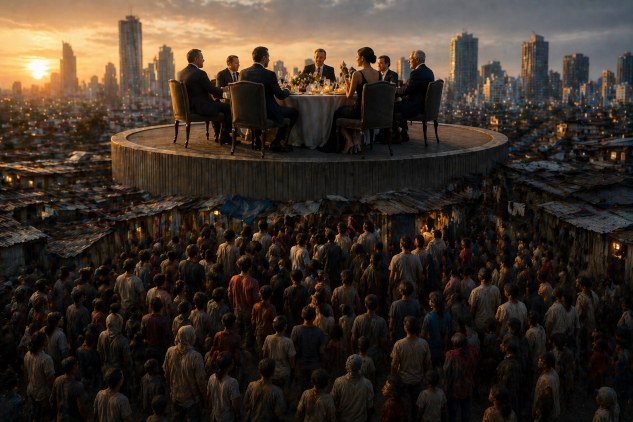
Sixty thousand human beings now control more wealth than the bottom half of humanity combined. That's fewer people than fill a football stadium holding more financial power than four billion souls.
In This Article
- How extreme wealth concentration reached historic peaks unseen in human history
- The mathematical impossibility of 60,000 individuals outowning 4 billion people
- Why this isn't just inequality but a fundamental threat to democracy itself
- The hidden mechanisms that funnel wealth upward while keeping it there
- What happens when societies reach this level of economic polarization
The World Inequality Report 2026 dropped a number so stark it defies comprehension. The top 0.001 percent of humanity owns three times more wealth than the entire bottom half. We're talking about fewer than 60,000 multimillionaires controlling more resources than four billion people.
Put that in perspective. You could fit all these wealth holders in a large stadium. The other group? That's half the planet.
This isn't garden-variety inequality. This is wealth concentration at levels that would make medieval kings blush. And unlike those old monarchies, this system operates under the cover of democratic rhetoric and free market mythology.
The Numbers Don't Lie But They Do Shock
Mathematics has a way of cutting through political spin. When 60,000 individuals possess more wealth than 4 billion people, we're looking at a ratio that breaks the human brain's ability to process fairness.
Consider this. If you lined up those 60,000 ultra-wealthy individuals shoulder to shoulder, the line would stretch about 35 miles. Now imagine trying to line up half of humanity. You'd need a line stretching around the Earth's equator 40 times.
The wealthy line owns more than the planetary one.
These aren't just big numbers. They represent a fundamental reorganization of human resources. We've created an economic system where a rounding error in one person's portfolio equals the entire lifetime earnings of thousands of families.
This concentration accelerated during the very years when global crises demanded collective solutions. While billions struggled with pandemic fallout, climate disasters, and economic uncertainty, the ultra-wealthy saw their fortunes multiply.
How We Built This Wealth Vacuum Cleaner
This level of concentration doesn't happen by accident. It requires carefully constructed systems that funnel money upward and keep it there.
Start with the tax code. While working families pay payroll taxes on every dollar they earn, investment income gets treated like a delicate flower. Capital gains rates sit well below wage rates. Dividend income enjoys special treatment. Inheritance taxes barely exist for the clever rich.
The ultra-wealthy don't get paychecks like normal humans. They get asset appreciation, stock options, and carried interest. These income streams enjoy tax advantages that wage earners never see.
Then there's the debt game. Regular folks borrow money to buy necessities and pay real interest rates. The wealthy borrow against their assets at rates that often sit below inflation. They're literally getting paid to borrow money.
Corporate structures add another layer. The same people who own the assets also control the companies that generate those assets. They set their own compensation, buy back their own stock, and structure their own tax strategies.
It's like playing poker when you deal the cards, set the rules, and count the money.
Democracy Versus Oligarchy
Here's where personal wealth becomes political power. Money doesn't just buy luxury goods. It purchases influence, access, and policy outcomes.
Those 60,000 ultra-wealthy individuals don't just own assets. They own media companies that shape public opinion. They fund think tanks that generate policy ideas. They hire lobbyists who write legislation. They contribute to campaigns that determine elections.
Meanwhile, the 4 billion people on the other side of this equation struggle to find time to vote between their multiple jobs.
Democratic theory assumes rough equality in political participation. But when one small group can fund entire political movements while another group can barely afford transportation to polling places, you don't have democracy. You have oligarchy with democratic decorations.
The wealthy don't need to conspire. Their interests naturally align around policies that protect and expand their advantages. Lower taxes on capital. Weaker labor laws. Reduced financial regulation. Trade policies that favor asset owners over workers.
They don't have to meet in smoke-filled rooms. They bump into each other at charity galas and policy conferences where admission costs more than most families' annual income.
The Compound Interest of Power
Extreme wealth doesn't just sit in bank accounts earning modest returns. It reproduces itself through mechanisms unavailable to ordinary people.
The ultra-wealthy buy assets that appreciate while providing income. Real estate that generates rent. Stocks that pay dividends. Businesses that create profits. Art that increases in value. These assets throw off enough cash to cover lavish lifestyles while the principal keeps growing.
Regular families spend their income on necessities. Rent, food, healthcare, education. They're lucky to save anything, much less invest in appreciating assets.
The mathematical result? Wealth compounds for those who already have it while staying flat or declining for everyone else.
But there's another compounding effect: influence. Wealth buys political power, which creates policies that generate more wealth, which purchases more political power. It's a feedback loop that strengthens with each cycle.
Consider how this plays out in education. Wealthy families buy access to elite schools, creating networks that provide business opportunities, which generate wealth that buys access to elite schools for the next generation. Meanwhile, public schools get underfunded because wealthy families don't use them and don't want to pay taxes to support them.
What History Teaches About Extreme Inequality
We've seen this movie before. The Gilded Age featured similar wealth concentration. A handful of industrialists controlled vast portions of national wealth while workers lived in poverty despite working dangerous jobs for long hours.
That era ended with economic collapse, social upheaval, and eventually policy changes that redistributed wealth and power. The New Deal. Progressive taxation. Strong labor unions. Financial regulation.
But those changes didn't happen automatically. They required economic crisis, political organizing, and leaders willing to challenge concentrated wealth.
The French Revolution provides a more dramatic example. When inequality reached extreme levels and aristocrats became completely divorced from common struggles, the entire system collapsed violently.
More recently, we can look at countries where extreme inequality persists. Social mobility disappears. Democratic institutions weaken. Economic growth slows because consumer demand can't keep up with productive capacity.
Aw shucks, it's almost like concentrating all the money with people who already have everything they could possibly buy hurts the economy that depends on people buying things.
The Real Cost of Concentrated Wealth
This isn't just about fairness or social justice. Extreme wealth concentration undermines the entire economic system.
Economies depend on circulation. Money needs to move through different hands, creating demand for goods and services. When wealth gets trapped at the top, circulation slows.
The wealthy can only consume so much. Once you own multiple homes, luxury cars, and expensive toys, additional wealth just piles up in investment accounts. It doesn't create demand for products and services that keep economies humming.
Meanwhile, the billions of people with limited resources would gladly spend money on necessities and modest luxuries if they had it. They represent massive untapped demand that could drive economic growth.
But they can't demand what they can't afford.
This creates a paradox. The same system that generates enormous wealth also destroys the broad-based purchasing power needed to sustain that wealth creation.
Eventually, even the wealthy suffer when their investments lose value because consumer demand collapses. But they suffer last and least, while everyone else bears the immediate costs.
Breaking the Concentration Machine
Extreme wealth concentration isn't a law of nature. It's the result of specific policy choices that can be changed.
Progressive taxation represents the most direct approach. Wealth taxes, inheritance taxes, and higher rates on investment income could slow the accumulation process. Some countries have implemented these policies successfully.
Labor organizing provides another lever. When workers can bargain collectively, they capture larger shares of the wealth their work creates. Strong unions correlate with lower inequality across different countries and time periods.
Financial regulation can limit the most egregious wealth extraction schemes. Rules that prevent stock buybacks, limit executive compensation, and restrict speculative trading could redirect corporate resources toward productive investment and worker compensation.
Political reforms matter too. Campaign finance limits, lobbying restrictions, and public financing of elections could reduce the political influence that wealth concentration creates.
But these changes require political coalitions strong enough to overcome the opposition that concentrated wealth can fund. That means the 4 billion people on the wrong side of this equation need to organize more effectively than the 60,000 people trying to maintain their advantages.
The math actually works in democracy's favor, if regular people can overcome the resource disadvantage.
Sixty thousand people can buy a lot of politicians, but they can't outvote 4 billion people who understand what's happening and decide to change it.
About the Author
 Robert Jennings is the co-publisher of InnerSelf.com, a platform dedicated to empowering individuals and fostering a more connected, equitable world. A veteran of the U.S. Marine Corps and the U.S. Army, Robert draws on diverse life experience, from real estate and construction to building InnerSelf.com with his wife, Marie T. Russell, bringing a practical, grounded perspective to life's challenges. InnerSelf grew from InnerSelf Magazine, founded by Marie T. Russell in 1985, which became InnerSelf.com in 1996. Decades later, InnerSelf continues to inspire clarity and empowerment.
This article is licensed under a Creative Commons Attribution-NonCommercial-NoDerivatives 4.0 License. You may share it with attribution to Robert Jennings, InnerSelf.com, and a link back to the original article at InnerSelf.com. Commercial use and derivative works are not permitted without permission.
Further Reading
-
Capital in the Twenty-First Century
This book gives readers the long historical view behind the article’s central point: wealth does not merely grow, it concentrates. It helps explain why fortunes at the top can expand faster than the broader economy and why that pattern eventually distorts politics, opportunity, and social stability. It is a strong choice for readers who want the structural logic behind today’s extreme inequality.
Amazon: https://www.amazon.com/exec/obidos/ASIN/1491534648/innerselfcom
-
Winners Take All: The Elite Charade of Changing the World
This title fits the article’s argument that concentrated wealth does not stop at economics but spills directly into power, image-making, and policy. It examines how elite influence can present itself as reform while leaving the underlying system untouched. Readers interested in the democracy-versus-oligarchy theme will find it especially relevant.
Amazon: https://www.amazon.com/exec/obidos/ASIN/0451493249/innerselfcom
-
Plutocrats: The Rise of the New Global Super-Rich and the Fall of Everyone Else
This book connects well with the article’s stark image of a tiny class holding outsized control over global resources. It explores how a transnational wealthy class emerged, how it sees itself, and why its rise has widened the gap between ordinary people and those at the top. It is particularly useful for readers who want the human and political story behind the numbers.
Amazon: https://www.amazon.com/exec/obidos/ASIN/1594204098/innerselfcom
Article Recap
The World Inequality Report 2026 reveals that fewer than 60,000 ultra-wealthy individuals now control more wealth than the bottom half of humanity combined, representing an unprecedented level of wealth concentration that threatens democratic institutions and economic stability. This extreme inequality results from specific policy choices around taxation, labor rights, and financial regulation that systematically funnel resources upward while limiting opportunities for broad-based prosperity.
#WealthInequality #EconomicJustice #DemocracyInDanger #WealthConcentration #SystemicInequality #PoliticalPower #EconomicPolicy #SocialJustice #ClassWarfare #WealthGap







