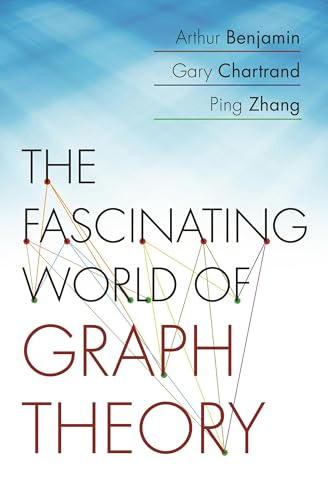
Graph theory might sound like an abstract mathematical concept relegated to dusty textbooks and university lecture halls, but it represents something far more profound: a universal language for understanding the fundamental connections that bind our world together. This mathematical framework offers readers a transformative lens through which to view reality itself, revealing the hidden architecture of relationships, networks, and systems that influence every aspect of our lives.
At its core, this exploration of graph theory teaches us how to map connections. Graphs are simply collections of points, called vertices, connected by lines called edges. Yet within this elegant simplicity lies extraordinary power. By learning to visualize and analyze these networks, you develop a new way of thinking about complexity. Whether you're examining social relationships, organizational structures, transportation systems, or the internet itself, graph theory provides the tools to understand how individual components interact to create larger wholes. This perspective shift alone can be profoundly empowering, offering clarity in situations that previously seemed chaotic or overwhelming.
The journey through these concepts begins with fundamental ideas and gradually builds toward deeper insights. Readers discover how graph theory helps us solve real-world problems that affect daily life. Consider how delivery companies optimize routes to minimize fuel consumption and time, how social media platforms identify communities and recommend connections, or how epidemiologists track disease transmission through populations. Understanding the principles behind these applications isn't merely intellectually satisfying; it awakens an appreciation for the intelligence embedded in systems we interact with constantly.
One of the most empowering aspects of studying graph theory is recognizing that many seemingly disparate problems share underlying mathematical structures. A networking challenge facing a business executive, a routing problem encountered by a logistics company, and a scheduling issue at a hospital might all be solved through similar graphical approaches. This recognition builds mental flexibility and creative problem-solving capacity. When you understand these universal patterns, you become capable of transferring solutions across different domains in your own life and work.
The exploration also reveals something deeper about interconnection itself. In our increasingly complex world, where isolation feels more common than community, graph theory reminds us that everything is connected. The paths between people, ideas, and resources matter tremendously. Network analysis teaches us that strength often lies not in individual nodes but in the quality and diversity of connections. For personal growth, this insight encourages us to invest intentionally in our relationships and community ties, recognizing their power to create opportunities, resilience, and meaning.
Throughout this mathematical journey, you'll encounter elegant theorems and surprising results that challenge intuition. Why does a small group of highly connected individuals matter more than a larger but loosely connected group? How can we identify the most influential nodes in a network? What makes some networks resilient while others collapse under stress? These questions have implications far beyond mathematics. They relate directly to leadership, influence, organizational effectiveness, and social change.
Moreover, learning to think in terms of graphs cultivates what might be called systemic consciousness. Rather than viewing problems in isolation, you begin seeing them as part of interconnected wholes. This systemic perspective is essential for personal empowerment in the modern era. Whether addressing health challenges, career advancement, relationship dynamics, or social issues, the ability to perceive underlying structures and connections enables more effective and compassionate responses.
The practical value extends to everyday decision-making. Understanding network principles helps you recognize which relationships to nurture, which opportunities offer the best connections, and how information flows through systems you inhabit. You become more strategic and intentional without becoming cynical, more aware without becoming overwhelmed.
This journey ultimately invites you into a world of elegant beauty where abstract mathematics reveals the deep patterns organizing reality. It's an invitation to see the extraordinary in the ordinary, to recognize your own position within vast networks of meaning and connection, and to develop the conceptual tools for navigating an increasingly complex world with wisdom and purpose.