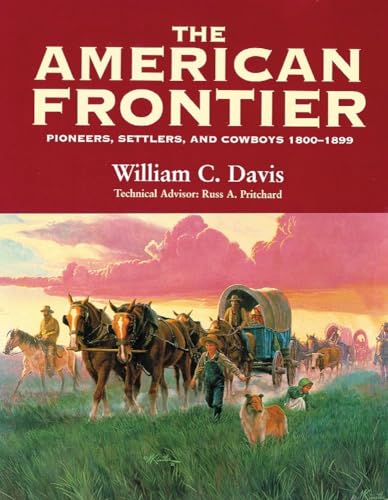
# The American Frontier: A Journey Into Character, Challenge, and the Making of Identity
The frontier represents far more than a geographical boundary or historical period. It embodies a fundamental human experience: the encounter with the unknown, the testing of one's character against overwhelming odds, and the opportunity to reinvent oneself in the face of wilderness and possibility. This comprehensive exploration of American frontier history offers readers a profound lens through which to examine not just a pivotal era in United States history, but also timeless principles about human resilience, community building, and the psychological dimensions of pioneering spirit.
Readers will discover how the expansion westward across North America was fundamentally shaped by ordinary individuals making extraordinary choices. Rather than presenting the frontier as a romantic narrative of inevitable progress, this work examines the complex motivations, fears, hopes, and transformations that drove millions of people to leave behind established communities and venture into unknown territory. The book presents detailed accounts of settlers, traders, soldiers, and Native Americans, revealing the multifaceted human drama that unfolded across diverse landscapes and generations.
What makes this historical narrative particularly valuable for contemporary readers seeking personal growth is its unflinching examination of how individuals and communities adapted to radical uncertainty. The frontier demanded constant problem-solving, resilience in the face of failure, and the ability to cooperate with strangers to achieve common survival goals. These themes resonate deeply in our modern era, where many people feel called to explore new territories in their own lives, whether metaphorical or literal. The book illuminates how ordinary people developed extraordinary capacities through necessity and circumstance.
The exploration covers the complete arc of frontier expansion, from early colonial settlements through the late nineteenth century, providing context for understanding how pioneering consciousness shaped American identity and values. Readers will encounter the diverse peoples who inhabited and shaped frontier regions: French fur traders building relationships across cultural lines, African Americans seeking freedom and opportunity, immigrants pursuing dreams of land ownership, and Native American nations defending their ancestral territories and ways of life. This multifaceted perspective prevents simplistic interpretation and instead reveals the frontier as a complex collision of cultures, ambitions, and worldviews.
One of the most transformative aspects of studying frontier history lies in recognizing how people managed profound transitions. The movement from agricultural village life to frontier settlement, from dependence on established institutions to self-reliance, from known landscapes to unmapped wilderness, all demanded significant psychological and spiritual adjustments. Readers will gain insight into human capacity for adaptation and the ways that challenge catalyzes growth. Understanding how historical figures navigated displacement, loss, and opportunity can illuminate our own relationship with change and the transitions we face in personal development journeys.
The book also provides valuable perspective on community formation and social consciousness. Frontier societies emerged without pre-existing hierarchies or institutions, forcing communities to establish governance, justice systems, and cooperative mechanisms from scratch. These experiments in social organization offer lessons relevant to anyone interested in creating conscious communities or contributing to social evolution. The compromises, conflicts, and creative solutions that emerged provide historical evidence of humanity's capacity to build functional societies based on shared purpose.
Furthermore, this historical study challenges readers to examine their own inherited narratives about progress, success, and American identity. By presenting the frontier experience with nuance and complexity, rather than mythology, the work encourages critical thinking about cultural narratives that shape our beliefs and aspirations. This kind of examination is essential for personal growth and developing greater social consciousness.
For anyone seeking to understand the roots of American character, the dynamics of human adaptation, or the ways communities form under pressure, this comprehensive historical work offers both intellectual satisfaction and personal insight. It demonstrates that growth often emerges at the intersection of necessity and opportunity, where individuals must draw upon inner resources they did not know they possessed.