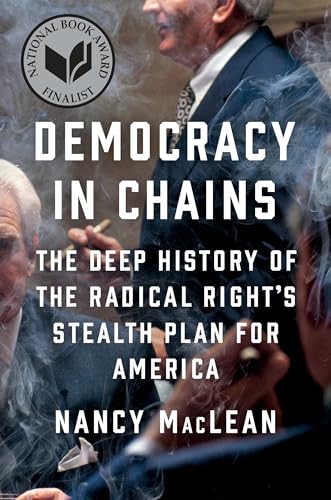

A careful examination of American political and economic history reveals a lesser-known narrative that challenges conventional assumptions about democracy and freedom. This groundbreaking work uncovers how a deliberate, decades-long campaign transformed the landscape of American governance and society, often hidden from public view yet profoundly shaping the world we inhabit today.
The journey begins with an exploration of influential thinkers and their ideas, tracing how certain economic philosophies were strategically promoted to reshape public policy and governance structures. Rather than presenting democracy as a straightforward expression of popular will, this work reveals how concentrated wealth and power have been leveraged to constrain democratic participation itself. Readers will discover the deliberate strategies employed to reframe fundamental questions about who should have a voice in governance and whose interests should be prioritized in policy decisions.
Throughout these pages, you'll encounter a cast of characters whose names may be unfamiliar but whose influence has been extraordinary. The narrative traces how specific individuals and institutions worked methodically to build a movement that would eventually reshape American political consciousness. What makes this exploration particularly revealing is how it demonstrates that this transformation was not inevitable or accidental, but rather the result of calculated, purposeful action spanning generations.
The work examines how economic theories were translated into concrete political power. Readers will learn how think tanks, educational institutions, and political networks functioned as interconnected parts of a larger system designed to advance particular interests. Rather than viewing these as separate phenomena, this investigation shows how they operated in concert to achieve specific objectives that often contradicted democratic principles and majority preferences.
One of the most valuable aspects of understanding this history is recognizing the disconnect between what we're told about how democracy works and how it actually functions when examined closely. This exploration challenges you to question assumptions about freedom, choice, and governance that most people accept without scrutiny. It asks uncomfortable questions about whose voices matter in political decisions and whose interests are protected by current systems.
The implications extend into contemporary life in multiple dimensions. From education policy to environmental regulation, from labor rights to voting access, the fingerprints of this long-running campaign appear throughout modern governance. By understanding how these systems developed and were maintained, readers gain insight into why certain policy debates persist and why some solutions seem perpetually out of reach despite majority support.
For those seeking personal growth and social consciousness, this material offers crucial context for understanding the broader environment in which individual and collective transformation must occur. How can we effectively address social problems when the very structures of decision-making have been systematically designed to limit accountability and democratic participation? What does it mean for personal empowerment when economic and political systems are structured to concentrate power rather than distribute it?
The book serves as a clarion call for critical thinking about institutions we often take for granted. It invites readers to become more conscious observers of political and economic processes, to ask who benefits from current arrangements, and to understand that present conditions are not inevitable but are the result of human choices that can be questioned and potentially altered.
This exploration ultimately matters because understanding power structures is essential for anyone committed to genuine social transformation. Whether your interest lies in politics, economics, social justice, or personal empowerment, comprehending how systems are constructed and maintained provides essential tools for creating meaningful change. The narrative demonstrates that democracy itself must be actively defended and that awareness of these mechanisms is the first step toward more conscious and intentional participation in shaping our collective future.