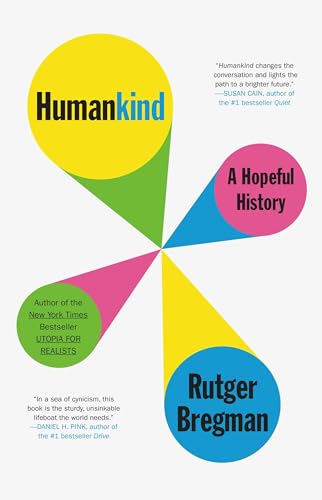
For centuries, we've been told a story about ourselves that shapes how we see human nature, organize our societies, and treat one another. It's a story that says humans are fundamentally selfish, aggressive, and self-interested. It suggests that civilization is merely a thin veneer covering our brutish instincts, and that without strict controls, we would descend into chaos. This narrative has influenced everything from our economic systems to our educational philosophies, from how we design our workplaces to how we raise our children.
What if that story is wrong? What if the evidence points to a radically different understanding of who we really are?
Drawing on cutting-edge research from archaeology, anthropology, psychology, and evolutionary biology, this groundbreaking work challenges the cynical view of human nature that has dominated Western thought. Through compelling evidence and unforgettable stories, readers discover that humans have actually evolved to be cooperative, kind, and capable of remarkable goodness. Our ability to work together, show empathy, and care for strangers isn't a cultural overlay on our "true" selfish nature—it's actually what made us successful as a species.
The journey begins by examining famous studies and historical events that supposedly prove human wickedness, from the Stanford Prison Experiment to the behavior of people during disasters and wars. Through meticulous research, these well-known examples are revealed to tell a very different story than we've been taught. The reality of how people actually behave in crisis situations—whether during the Blitz in London, after Hurricane Katrina, or in the aftermath of 9/11—consistently shows humans rising to help one another rather than descending into savagery.
Readers explore fascinating archaeological findings that overturn conventional wisdom about our ancestors. Evidence from prehistoric sites suggests that early humans were far more egalitarian, peaceful, and cooperative than we've imagined. The transition to agriculture and settled civilization brought significant changes, but not the ones we typically assume. Understanding this real history provides crucial insights into the social structures that either bring out the best or worst in human behavior.
The implications for personal empowerment are profound. If we've been operating under a fundamentally mistaken view of human nature, then we've been limiting our own potential and that of others around us. When we expect the worst from people, we often get it—not because that's their true nature, but because our systems, structures, and assumptions create self-fulfilling prophecies. Conversely, when we create environments based on trust and assume good intentions, people generally rise to meet those expectations.
This shift in perspective offers practical wisdom for transforming every area of life. In parenting, it suggests radically different approaches than those based on control and punishment. In the workplace, it points toward organizational structures that unleash creativity and engagement rather than managing people as if they need constant surveillance. In education, it validates methods that trust in children's natural curiosity and capacity for learning rather than relying primarily on external rewards and punishments.
For those on a path of personal growth, this work provides scientific validation for what many spiritual traditions have long taught: that our essential nature includes compassion, connection, and the capacity for tremendous good. Rather than needing to transcend or overcome a fundamentally flawed nature, the journey becomes one of creating conditions where our better angels can flourish.
The book doesn't shy away from acknowledging human capacity for cruelty and violence. Instead, it examines the specific conditions and systems that bring out these behaviors, offering insights into how we might redesign our institutions to reduce harm and promote wellbeing. Understanding what actually motivates destructive behavior provides a roadmap for change at both individual and societal levels.
For readers seeking to contribute to positive social change, this perspective is transformative. It suggests that building a better world isn't about forcing compliance or managing inherently selfish impulses, but about creating structures that align with our cooperative nature. This hopeful yet rigorously evidence-based vision empowers individuals to see their efforts toward creating more compassionate communities as working with human nature rather than against it, making meaningful change feel not just possible, but natural.