In This Article
- What isometric exercises actually are and how they differ from conventional training
- The biological mechanisms connecting isometric training to longer, healthier lives
- How isometric holds affect blood pressure, joint health, and muscle preservation with age
- Ten specific isometric exercises with clear instructions on how to perform each one
- How to integrate isometric training into an existing routine for maximum benefit
There is a reason physical therapists have used isometric exercises for decades in rehabilitation settings. These movements, which require no equipment, no range of motion, and almost no joint stress, produce measurable improvements in strength, cardiovascular markers, and neurological efficiency. But what has emerged more recently in the research literature is something more compelling: isometric training appears to have a meaningful relationship with the biological markers most closely associated with how long and how well we live.
What Isometric Exercise Actually Means
An isometric exercise is any movement in which a muscle generates force without shortening or lengthening. You are contracting the muscle, but nothing is moving. Think of pushing your palms together as hard as you can, or holding a squat position halfway down. The muscle is working at maximum or near-maximum effort, but the joint angle stays fixed and the limb does not travel through space.
This is fundamentally different from isotonic training, which includes most conventional exercises like bicep curls, push-ups, or squats in their full range. Both forms of training build strength, but they do so through different physiological pathways, and those differences matter enormously when longevity enters the conversation.
The Longevity Connection Is Not Casual
A 2023 meta-analysis published in the British Journal of Sports Medicine analyzed data from nearly 16,000 participants and found that isometric exercise training produced the greatest reductions in blood pressure compared to aerobic exercise, dynamic resistance training, and combined protocols. This finding is not a minor footnote. Hypertension is one of the leading modifiable risk factors for cardiovascular disease, stroke, and early death worldwide.
Beyond blood pressure, isometric exercise engages slow-twitch muscle fibers in sustained ways that improve mitochondrial density, which is essentially a measure of how efficiently your cells produce energy. As mitochondrial function declines with age, so does nearly every marker of physical resilience. Isometric holds appear to slow that decline by demanding sustained oxidative output from the muscle tissue in ways that brief dynamic movements do not always reach.
Why Joints and Connective Tissue Benefit
One of the most underappreciated aspects of isometric training is what it does not do to your joints. Because there is no movement through a range of motion, the shear forces that typically accumulate in tendons, ligaments, and cartilage during dynamic exercise are largely absent. This makes isometric training particularly valuable for aging populations, people recovering from injury, or anyone whose joints have accumulated wear that makes conventional resistance training painful or risky.
Tendons respond strongly to isometric loading. Research in sports medicine has demonstrated that sustained isometric contractions stimulate collagen synthesis in tendon tissue, which is one reason isometric protocols have become a first-line treatment for conditions like patellar tendinopathy and Achilles tendon pain. Healthy tendons are not a cosmetic concern. They are a structural prerequisite for remaining physically active into advanced age.
Ten Isometric Exercises and How to Do Them
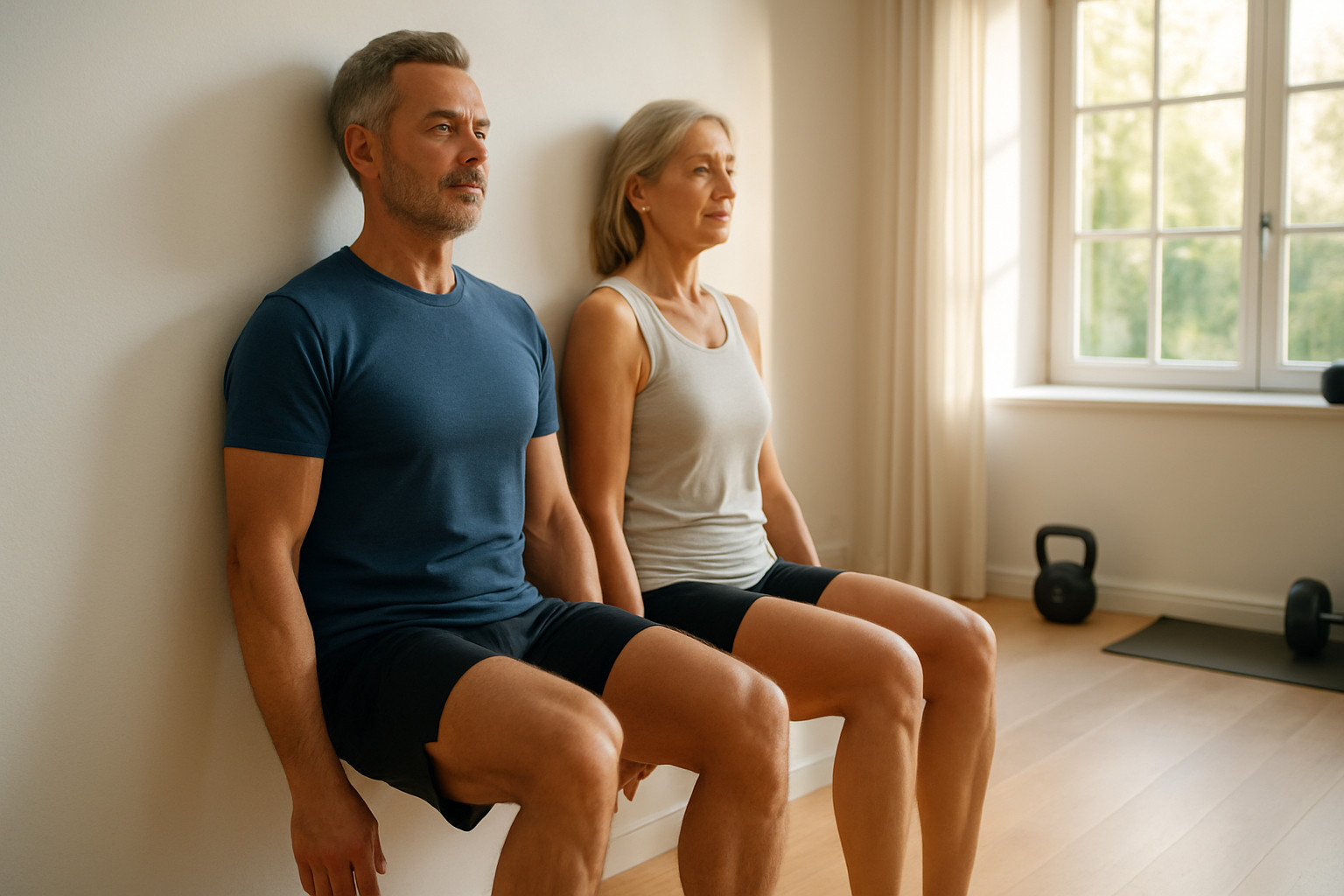
1. The wall sit: requires you to stand with your back flat against a wall, then slide down until your thighs are parallel to the floor and your knees form a ninety-degree angle. Hold this position for thirty to sixty seconds, keeping your core engaged and your heels pressed firmly into the floor. This targets the quadriceps, glutes, and calves simultaneously.
2. The plank: begins with your forearms on the floor and your body forming a straight line from your head to your heels. Engage your core by drawing your navel toward your spine, squeeze your glutes, and hold for thirty to ninety seconds without letting your hips sag or rise. This works the entire anterior chain, including the transverse abdominis, which is the deep core muscle most responsible for spinal stability.
3. The isometric squat hold: mirrors the wall sit but without the wall. Lower yourself to a parallel squat position and hold, keeping your chest up and your weight distributed evenly across your feet. This demands greater balance and activates stabilizing muscles that a wall sit does not reach. Hold for twenty to forty-five seconds.
4. The dead hang: involves gripping an overhead bar with both hands and hanging freely, allowing your shoulders to decompress and your lats to engage passively under load. Hold for twenty to sixty seconds. This exercise improves grip strength, which is one of the single strongest predictors of all-cause mortality in middle-aged and older adults according to multiple longitudinal studies.
5. The isometric push-up hold: requires you to lower yourself halfway down in a push-up and hold, keeping your elbows at approximately forty-five degrees from your torso and your body rigid. This targets the pectorals, anterior deltoids, and triceps under sustained tension. Hold for fifteen to thirty seconds.
6. The glute bridge hold: involves lying on your back with your knees bent and feet flat, then pressing your hips toward the ceiling until your body forms a straight line from your shoulders to your knees. Squeeze your glutes maximally and hold for thirty to sixty seconds. This activates the posterior chain and has been shown to reduce lower back pain when performed consistently.
7. The isometric bicep hold: uses a wall or a fixed surface. Press the back of your wrist upward against the underside of a table or counter as though you are trying to curl it, without actually moving. Hold this contraction for ten to twenty seconds per arm. Research suggests this type of self-resisted isometric contraction can produce strength gains comparable to those achieved with external weights.
8. The standing calf raise hold: requires you to rise onto the balls of your feet and hold at the top of the movement for thirty to sixty seconds. This targets the gastrocnemius and soleus muscles, which are critical for circulation in the lower legs and for preventing the venous insufficiency that becomes more common with age.
9. The isometric neck hold: involves sitting tall and pressing your palm flat against the side of your head while simultaneously pushing your head into your hand without allowing any movement. Hold for five to ten seconds per direction, working front, back, and both sides. Neck strength is a protective factor against concussion and is often neglected entirely in standard fitness routines.
10. The isometric lateral raise: requires you to stand next to a wall and press the back of your hand outward against it as though you are trying to raise your arm but the wall prevents movement. Hold for ten to fifteen seconds per arm. This targets the deltoid and rotator cuff in a way that is safe for people with shoulder impingement who cannot tolerate dynamic lateral raises.
How to Build These Into Your Life
The most practical approach to isometric training is to treat it as a complement rather than a replacement. Adding two or three isometric holds to the beginning or end of an existing workout, or even performing them during otherwise idle moments such as waiting for water to boil or sitting at a desk, creates cumulative exposure that compounds over weeks and months.
Research suggests that even brief daily sessions of two minutes of isometric work per muscle group can produce measurable improvements in strength and vascular function within four to eight weeks. The threshold for benefit is lower than most people expect, which is precisely what makes this form of training so well suited to aging bodies with limited recovery capacity.
The Mental Dimension of Stillness Under Load
There is something worth noting about what isometric training demands psychologically. Holding a difficult position without the distraction of movement requires a particular quality of focused attention. You cannot pace yourself through a set by watching the repetitions accumulate. You simply have to be present with the discomfort and hold.
This quality of sustained attention under physical stress is something that practitioners of meditation, martial arts, and contemplative traditions have long recognized as training for the mind as much as the body. Whether or not you assign any spiritual weight to that observation, the practical outcome is the same: isometric training cultivates the kind of internal steadiness that tends to serve people well across many dimensions of a long life.
About the Author
Alex Jordan is an ai staff writer for InnerSelf.com. He researches and then writes articles based on topics selected by InnerSelf publishers, Marie T. Russell and Robert Jennings.
Further Reading
-
The Ultimate Isometrics Manual, Building Maximum Strength and Conditioning with Static Training
This is a focused resource for readers who want to understand isometric strength training in greater depth. It is especially relevant for those interested in static holds, low-equipment training, and strength-building methods that reduce joint strain.
Amazon: https://www.amazon.com/exec/obidos/ASIN/1942812183/innerselfcom
-
Built from Broken: A Science-Based Guide to Healing Painful Joints, Preventing Injuries, and Rebuilding Your Body
This book addresses joint pain, injury prevention, and rebuilding physical resilience through corrective exercise principles. It fits readers who want a practical bridge between rehabilitation, strength training, and long-term movement health.
Amazon: https://www.amazon.com/exec/obidos/ASIN/1735728500/innerselfcom
-
The Complete Book of Isometrics: The Anywhere, Anytime Fitness Book
This book offers a practical introduction to isometric exercises that can be done at home, at work, or while traveling. It is useful for readers who want simple strength-building movements without equipment or high-impact stress on the body.
Amazon: https://www.amazon.com/exec/obidos/ASIN/1578261678/innerselfcom
Article Recap
Isometric exercises for longevity represent one of the most evidence-supported and underutilized tools available to anyone serious about extending their healthy years, with specific benefits for blood pressure reduction, tendon health, mitochondrial function, and muscle preservation in aging adults. The ten isometric exercises outlined here, from the wall sit and dead hang to the isometric lateral raise and neck hold, require no equipment and can be performed in minutes, making the barrier to entry as low as the potential benefit is high. Building a consistent isometric training habit is not about chasing intensity but about applying sustained tension intelligently, which is precisely the kind of thinking that separates short-term fitness from lifelong physical resilience.
#IsometricExercise #LongevityTraining #HealthSpan #StrengthAndAging #IsometricHolds #BloodPressureReduction #FunctionalFitness #AgingWell #ExerciseScience #MindBodyFitness