The experience of love often comes with physical symptoms like nausea and anxiety, a reality recognized throughout history. Medieval medicine linked these feelings to an imbalance of bodily humors, particularly in melancholic individuals. Treatments of the time included dietary changes and herbal remedies, reflecting a deep understanding of the connection between emotional and physical well-being.
In This Article
- What are the symptoms of love-related distress?
- How did medieval medicine explain lovesickness?
- What treatments existed for unrequited love in the past?
- How do historical views on love inform modern understanding?
- What are the risks of romanticizing the pain of love?
Love sure does hurt, as the Everly Brothers knew very well. And while it is often romanticised or made sentimental, the brutal reality is that many of us experience fairly unpleasant symptoms when in the throes of love. Nausea, desperation, a racing heart, a loss of appetite, an inability to sleep, a maudlin mood – sound familiar?
Today, research into the science of love recognises the way in which the neurotransmitters dopamine, adrenalin and serotonin in the brain cause the often-unpleasant physical symptoms that people experience when they are in love. A study in 2005 concluded that romantic love was a motivation or goal-orientated state that leads to emotions or sensations like euphoria or anxiety.
But the connection between love and physical affliction was made long ago. In medieval medicine, the body and soul were closely intertwined – the body, it was thought, could reflect the state of the soul.
Humoral imbalance
Medical ideas in the Middle Ages were based on the doctrine of the four bodily humours: blood, phlegm, black bile and yellow bile. In a perfectly healthy person, all four were thought to be perfectly balanced, so illness was believed to be caused by disturbances to this balance.
Such ideas were based on the ancient medical texts of physicians like Galen, who developed a system of temperaments which associated a person’s predominant humour with their character traits. The melancholic person, for example, was dominated by the humour of black bile, and considered to have a cold and dry constitution.
And as my own research has shown, people with a melancholic disposition were thought, in the Middle Ages, to be more likely to suffer from lovesickness.
The 11th-century physician and monk, Constantine the African, translated a treatise on melancholia which was popular in Europe in the Middle Ages. He made clear the connection between an excess of the black bile of melancholy in the body, and lovesickness:
The love that is also called ‘eros’ is a disease touching the brain … Sometimes the cause of this love is an intense natural need to expel a great excess of humours … this illness causes thoughts and worries as the afflicted person seeks to find and possess what they desire.
Curing unrequited love
Towards the end of the 12th century, the physician Gerard of Berry wrote a commentary on this text, adding that the lovesick sufferer becomes fixated on an object of beauty and desire because of an imbalanced constitution. This fixation, he wrote, causes further coldness, which perpetuates melancholia.
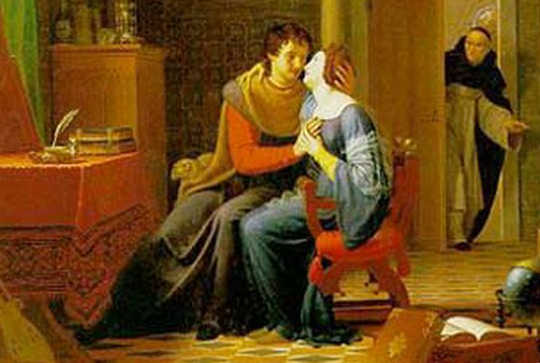
Whoever is the object of desire – and in the case of medieval religious women, the beloved was often Christ – the unattainability or loss of that object was a trauma which, for the medieval melancholic, was difficult to relieve.
But since the condition of melancholic lovesickness was considered to be so deeply rooted, medical treatments did exist. They included exposure to light, gardens, calm and rest, inhalations, and warm baths with moistening plants such as water lilies and violets. A diet of lamb, lettuce, eggs, fish, and ripe fruit was recommended, and the root of hellebore was employed from the days of Hippocrates as a cure. The excessive black bile of melancholia was treated with purgatives, laxatives and phlebotomy (blood-letting), to rebalance the humours.
Tales of woe
It is little wonder, then, that the literature of medieval Europe contains frequent medical references in relation to the thorny issue of love and longing. Characters sick with mourning proliferate the poetry of the Middle Ages.
The grieving Black Knight in Chaucer’s The Book of the Duchess mourns his lost beloved with infinite pain and no hope of a cure:
This ys my peyne wythoute red (remedy),
Alway deynge and be not ded.
In Marie de France’s 12th-century Les Deus Amanz, a young man dies of exhaustion when attempting to win the hand of his beloved, who then dies of grief herself. Even in life, their secret love is described as causing them “suffering”, and that their “love was a great affliction”. And in the anonymous Pearl poem, a father, mourning the loss of his daughter, or “perle”, is wounded by the loss: “I dewyne, fordolked of luf-daungere” (I languish, wounded by unrequited love).
The entirety of John Gower’s 14th-century poem, Confessio Amantis (The Lover’s Confession), is framed around a melancholic lover who complains to Venus and Cupid that he is sick with love to the point that he desires death, and requires a medicine (which he has yet to find) to be cured.
The lover in Confessio Amantis does, finally, receive a cure from Venus. Seeing his dire condition, she produces a cold “oignement” and anoints his “wounded herte”, his temples, and his kidneys. Through this medicinal treatment, the “fyri peine” (fiery pain) of his love is dampened, and he is cured.
The medicalisation of love has perpetuated, as the sciences of neurobiology and evolutionary biology show today. In 1621, Robert Burton published the weighty tome The Anatomy of Melancholy. And Freud developed similar ideas in the early 20th century, in the book Mourning and Melancholia. The problem of the conflicted human heart clearly runs deep.
So if the pain of love is piercing your heart, you could always give some of these medieval cures a try.
About The Author
Laura Kalas Williams, Postdoctoral Researcher in Medieval Literature and Medicine, Associate Tutor, University of Exeter
This article was originally published on The Conversation. Read the original article.
Further Reading
-
Lovesickness in the Middle Ages: The Viaticum and Its Commentaries
Mary Frances Wack examines how medieval physicians understood lovesickness as both a bodily and emotional disorder. This scholarly work is especially useful for readers interested in the older medical roots of romantic suffering, melancholy, desire, and imbalance.
Amazon: https://www.amazon.com/exec/obidos/ASIN/081228142X/innerselfcom
-
The Anatomy of Melancholy
Robert Burton’s classic work gathers early modern thinking on sadness, longing, love, illness, and the restless human mind. It offers a broad historical window into how emotional suffering was once treated as a deeply interwoven condition of body, spirit, habit, and imagination.
Amazon: https://www.amazon.com/exec/obidos/ASIN/0940322668/innerselfcom
-
Medieval Medicine: A Reader
Faith Wallis brings together translated medieval medical writings that illuminate how physicians, monks, scholars, and healers understood disease and treatment. The collection gives useful context for humoral theory, bodily balance, melancholy, and the medical worldview behind medieval cures.
Amazon: https://www.amazon.com/exec/obidos/ASIN/1442601035/innerselfcom
Recap:
The pain of love has long been documented, with medieval medicine offering insights into its causes and treatments. Exploring these historical perspectives can deepen understanding of love's impact on emotional and physical health.
#InnerSelfcom #Lovesickness #MedievalMedicine #EmotionalHealth #Neurobiology #CulturalHistory #MentalHealth #RomanticLove