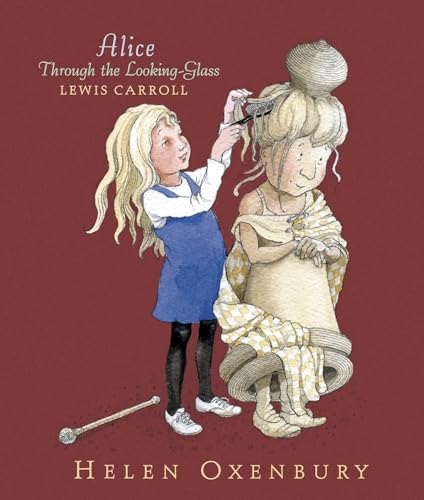









Journey into a realm where logic bends, language transforms, and the boundaries between sense and nonsense dissolve into profound wisdom. This timeless classic invites readers to venture beyond the ordinary mirror of everyday consciousness into a landscape where nothing operates according to conventional rules—yet everything contains surprising truths about existence, identity, and personal transformation.
The narrative follows a young protagonist who steps through a looking glass into an inverted world where chess pieces come to life, words mean whatever the speaker intends them to mean, and progress often requires moving backward. On the surface, this appears to be a whimsical adventure story filled with clever wordplay and fantastical characters. However, for those seeking deeper meaning, it serves as a sophisticated exploration of perception, consciousness, and the constructed nature of reality itself.
At its heart, this work examines how our habitual ways of thinking limit our understanding of who we are and what's possible. The looking glass represents the threshold between conditioned consciousness and expanded awareness. By crossing this boundary, readers encounter characters and situations that challenge fundamental assumptions about logic, identity, language, and truth. Each interaction becomes a mirror reflecting back our own unexamined beliefs about how the world should work.
The protagonist's encounters with various characters—each operating according to their own peculiar logic—illustrate how meaning is not fixed but depends on perspective and intention. When characters insist that words mean only what they decide they mean, this isn't nonsense but a profound commentary on the power of consciousness to shape reality. This principle holds tremendous relevance for anyone engaged in personal growth work, as it suggests that by shifting our internal narratives and interpretations, we literally reshape our experience of existence.
The chess game structure that frames the entire journey offers valuable lessons about strategy, intention, and understanding one's position within larger systems. Each move forward brings new challenges and unexpected consequences, reflecting how genuine transformation rarely follows a straightforward path. Progress requires embracing paradox, accepting ambiguity, and releasing attachment to predetermined outcomes. These are essential principles for anyone committed to authentic personal evolution.
The use of language and wordplay throughout functions as a teaching tool, demonstrating how our unconscious relationship with words constrains or expands our thinking. When we examine language more consciously—noticing how words can be interpreted multiple ways, how meaning emerges from context, how communication often miscarries between parties operating from different frameworks—we gain freedom to think and express ourselves more authentically. This meta-awareness of language itself becomes a gateway to psychological and spiritual liberation.
The various encounters with authority figures, social conventions, and "proper" behavior reveal how external rules and expectations can suffocate authentic expression and natural creativity. The queen's arbitrary judgments, the rules of etiquette that bind characters into ridiculous situations, and the general topsy-turvy nature of social order all encourage readers to question which rules and conventions they've internalized without examination. This questioning is essential for anyone seeking to live more authentically and consciously.
Throughout the journey, the protagonist maintains her essential self even while surrounded by chaos and contradiction. She questions, observes, maintains her own perspective, and ultimately awakens from the dream. This arc models the development of conscious self-awareness—the ability to maintain one's center while engaging with confusing, contradictory, and bewildering experiences.
For readers committed to personal growth and spiritual development, this work offers a sophisticated manual disguised as children's fantasy. It teaches that reality is far more flexible than we typically assume, that consciousness shapes experience, that liberation comes through questioning our assumptions, and that the journey inward ultimately transforms our understanding of everything. It reminds us that growth often requires stepping through thresholds into unfamiliar territory where our old maps no longer apply—and that this disorientation, properly understood, is itself the gateway to transformation.