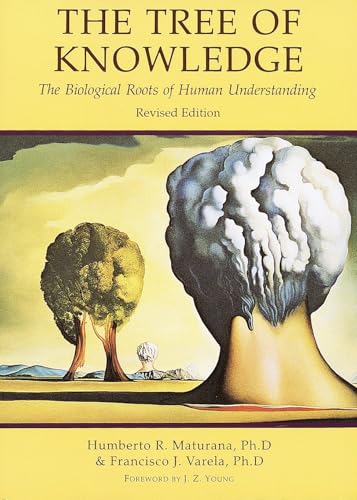
# Understanding Reality Through Living Systems: A Path to Personal and Collective Awakening
Have you ever wondered why two people can experience the same event and walk away with completely different understandings? Or why your perception of reality might be fundamentally different from someone else's, yet both feel equally real and valid? These questions lie at the heart of a groundbreaking exploration that challenges our most basic assumptions about knowledge, consciousness, and what it means to be human.
This profound work presents a revolutionary framework for understanding how we know what we know and why our individual realities are constructed the way they are. Rather than treating knowledge as a fixed collection of objective truths waiting to be discovered, the exploration presented here reveals knowledge as something far more dynamic and intimately connected to life itself. The foundation of this understanding rests on the biology of cognition, the recognition that knowing is not separate from living but is instead an inseparable aspect of how living systems maintain themselves.
Central to this transformative work is the concept of structural coupling, an idea that fundamentally reshapes how we understand our relationship with the world and with each other. Structural coupling describes how living organisms, including humans, are not passive observers of a pre-existing reality but rather active participants in the creation of our experienced worlds. Your nervous system, your body, and your history of interactions with your environment have shaped what you can perceive and how you interpret those perceptions. This means that reality as you experience it is not an objective recording of what exists out there, but rather a construction created through the dynamic interaction between your biological structure and the environment.
This distinction carries profound implications for personal empowerment and human relationships. If you begin to understand that your reality is generated through your interactions rather than simply received from the world, you gain tremendous freedom. You recognize that changing how you interact, how you pay attention, and how you engage with others can literally change your experienced reality. This is not about wishful thinking or denial of physical facts, but rather about understanding the active role you play in the construction of meaning.
The exploration also delves deeply into how language shapes our reality in ways we rarely recognize. Language is not merely a tool for describing a reality that already exists independently of us. Rather, language is where humans generate worlds together. Through conversation and communication, we literally bring new realities into being. This understanding opens doors to recognizing how your conversations, both internal and external, are actively creating the world you inhabit. Every conversation is an opportunity for transformation.
Perhaps most relevant to personal growth and social consciousness is the examination of how love operates as a biological phenomenon. Here, love is presented not as an abstract emotion or romantic ideal, but as a fundamental biological reality that explains human nature. The capacity to accept the legitimacy of another's perspective, to move into genuine dialogue rather than argumentation, to expand the range of behaviors we will accept from another—these are expressions of love operating at the biological level. This reframing offers powerful insights into why acceptance, genuine listening, and the ability to see from another's perspective are essential not just for spiritual development but for human survival and flourishing.
For anyone seeking personal empowerment, this work provides conceptual tools for understanding your own responsibility in creating your experience. You are not a victim of objective circumstances but a participant in bringing your reality into being through your observations, conversations, and interactions. This recognition can be genuinely liberating.
Furthermore, for those concerned with social consciousness and the collective future, the framework presented here explains why genuine social change requires shifts in how we interact with each other, not merely changes in external structures. When we understand that our realities are generated through our interactions, we see why creating different conversations and relationships is the true foundation for creating different societies.
This is essential reading for anyone ready to understand the deep connection between personal transformation and how we collectively generate the worlds we inhabit.