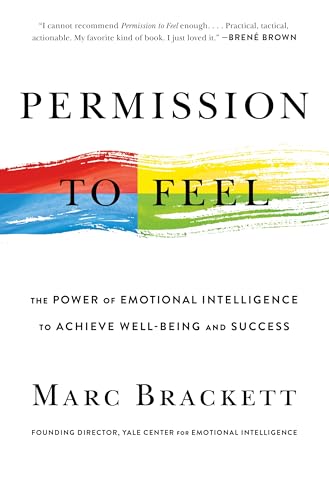
# Permission to Feel: Understanding Emotional Intelligence for Personal Transformation
Discover a revolutionary approach to understanding and managing the most fundamental aspect of human experience: emotion. This groundbreaking exploration published by Celadon Books offers readers a comprehensive framework for developing emotional intelligence that extends far beyond traditional self-help advice.
At its core, this work addresses a critical gap in modern education and personal development. Most people spend years learning mathematics, history, and science, yet receive virtually no formal training in understanding their own emotional landscape. This oversight has profound consequences, affecting everything from mental health and physical wellness to relationships, workplace success, and overall life satisfaction. The material presented here fills that essential gap by providing practical, scientifically-grounded tools for anyone seeking deeper self-awareness and emotional mastery.
The central thesis revolves around a compelling concept: emotions are not obstacles to overcome or weaknesses to hide, but rather valuable data that deserves careful attention and interpretation. Rather than viewing feelings as problems requiring suppression, readers will learn to recognize emotions as signals offering important information about what matters to them, what threatens them, and how they can respond more effectively to life's challenges. This paradigm shift alone can be transformative, offering permission to feel without guilt or shame while simultaneously developing the wisdom to respond thoughtfully rather than react impulsively.
Throughout these pages, readers encounter the Four Permitting Beliefs that form the philosophical foundation: believing that all emotions are valid, that emotions are important sources of information, that feelings deserve attention and respect, and that everyone has the right to feel. These principles might seem simple on the surface, yet they challenge deeply ingrained cultural conditioning that encourages emotional suppression, particularly among men and in professional environments.
The practical framework presented here goes beyond mere emotional awareness to teach the skill of emotional granularity—the ability to identify and name subtle distinctions between similar feelings. Most people navigate life using only a handful of emotional labels: happy, sad, angry, stressed. This limited emotional vocabulary constrains our ability to understand ourselves deeply. By expanding this vocabulary, readers develop greater precision in recognizing what they truly feel, which directly improves decision-making, relationship quality, and personal resilience.
Readers will discover how to apply these insights across different life domains. At home, the tools help parents and partners communicate more effectively and build stronger relationships based on genuine understanding rather than assumptions. In schools, these principles transform classroom dynamics and student engagement. In workplaces, emotional intelligence becomes a key differentiator in leadership effectiveness and team collaboration. In healthcare settings, these approaches improve patient outcomes and provider wellbeing. The universal applicability of this framework makes it valuable for anyone seeking to enhance their relationships and effectiveness in any context.
The material draws on decades of research conducted at the Yale Center for Emotional Intelligence, bringing scientific credibility to what many intuitively sense: that our relationship with emotion fundamentally shapes our wellbeing. Rather than relying solely on theory, readers encounter real-world examples and case studies that illustrate how these principles operate in actual human lives. This grounding in practical reality makes the concepts accessible and immediately applicable.
Perhaps most importantly, this work challenges the cultural narratives that have taught so many people to fear, minimize, or distrust their emotional experiences. By offering permission to feel fully and authentically, it opens pathways to greater self-compassion and genuine connection with others. For anyone interested in personal growth, emotional wellness, or creating more meaningful relationships, this comprehensive guide provides both the permission and the practical tools necessary for authentic transformation.