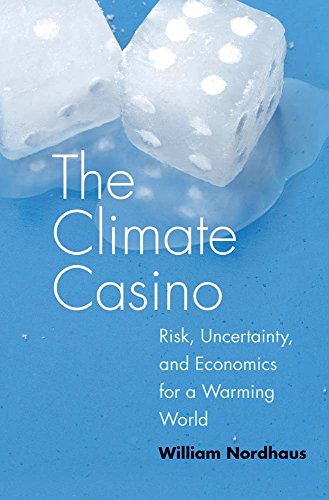



Understanding the profound economic and scientific realities of climate change represents one of the most crucial forms of personal and collective empowerment available today. This comprehensive exploration bridges the gap between complex environmental science, economic theory, and practical policy solutions, offering readers the knowledge needed to grasp humanity's greatest challenge and their role in addressing it.
At its core, this work demystifies the relationship between human activity, greenhouse gas emissions, and global warming through the lens of economic analysis. Rather than approaching climate change as merely an environmental or political issue, the framework presented here treats it as a risk management challenge that affects every aspect of our lives, from the food we eat to the communities we build, from our financial security to our children's futures.
Readers discover why climate change functions like a massive casino where humanity has placed an enormous bet. The metaphor proves illuminating: we're gambling with planetary systems we don't fully understand, risking catastrophic outcomes while hoping for favorable results. Unlike traditional casinos, however, the house doesn't simply take our money—the stakes involve the stability of ecosystems, agricultural systems, coastal cities, and the very foundations of modern civilization.
The analysis walks through the fundamental science in accessible terms, explaining how carbon dioxide and other greenhouse gases trap heat, why small temperature changes matter enormously, and what feedback loops mean for future warming. Beyond the science, readers gain insight into the economic dimensions of climate change: how to value future environmental damage today, why markets alone cannot solve this problem, and what kinds of policy interventions might actually work.
One of the most valuable contributions comes through the introduction of integrated assessment models—sophisticated tools that combine climate science, economic projections, and policy analysis. These models help us understand not just what might happen to the planet, but what it will cost us in economic terms and how different policy choices today ripple through decades and centuries. For those seeking to make informed decisions about their own lives, investments, and political choices, this framework provides essential context.
The work tackles crucial questions about carbon pricing, including carbon taxes and cap-and-trade systems. Readers learn why putting a price on carbon emissions represents one of the most efficient ways to reduce greenhouse gas pollution, how such systems work in practice, and what obstacles stand in the way of implementation. This knowledge empowers individuals to evaluate policy proposals critically and advocate effectively for meaningful change.
Particularly valuable for personal empowerment is the honest assessment of where we stand. The analysis doesn't sugar-coat the challenge or pretend easy solutions exist. Instead, it provides realistic scenarios ranging from relatively mild warming to catastrophic outcomes, helping readers understand the genuine stakes involved. This clarity enables more authentic engagement with the issue, moving beyond both denial and despair toward informed action.
The international dimensions receive careful attention, exploring why global cooperation proves so difficult yet so essential. Readers gain perspective on the different interests of developed and developing nations, the free-rider problem that undermines voluntary action, and what kinds of international agreements might actually succeed. This global perspective helps individuals see their personal choices within a larger context of collective action.
For those concerned with leaving a better world for future generations, the discussion of intergenerational ethics proves particularly illuminating. How should we value the wellbeing of people not yet born? What do we owe to future generations? These questions move beyond abstract philosophy to concrete policy implications that affect decisions being made right now.
Ultimately, this exploration offers something rare: a clear-eyed, scientifically grounded, and economically sophisticated analysis that empowers readers to understand one of civilization's defining challenges. Armed with this knowledge, individuals can make more informed personal choices, engage more effectively in democratic processes, and contribute meaningfully to the most important conversation of our time. Understanding these dynamics transforms passive anxiety about climate change into active, informed engagement—the very essence of personal empowerment.