The upcoming supermoon on April 26 offers a unique opportunity to observe our natural satellite at its closest approach to Earth. Learn about the Moon's phases, its elliptical orbit, and the optical illusion that makes it appear larger near the horizon. Discover the best times to catch this celestial event.
In This Article
- What causes the supermoon phenomenon?
- How do the Moon's phases work?
- What is the significance of perigee and apogee?
- How can the supermoon be best observed?
- What are the misconceptions about the Moon's size?
No matter where you are in the world, and no matter how light the skies are, the Moon is always there. Our only natural satellite has inspired literature, art and science for thousands of years.
As the days lengthen in the northern hemisphere, it gets harder to spot some of the fainter stars in the sky. But our Moon is still there, and every few months we have a special sighting.
Not only is the Moon on 26 April a full Moon, it’s also what is known as a supermoon – and the first of the year. To understand why it is a supermoon, it’s important to understand a little more about why different parts of the Moon are lit up at different times of the month, and also a little more about the Moon’s orbit.
Phases of the Moon
The reason we see different proportions of the Moon illuminated at different times of the month, or in different phases, is that the Moon is at different points in its orbit around Earth relative to the Sun.
When the Moon, the Earth and the Sun are all lined up together with the Earth between the Moon and Sun, sunlight shines on the whole lunar surface and is reflected back to Earth. On Earth, this is known as a full Moon.
When the Moon is between Earth and the Sun, no sunlight can reflect off its surface, and this is a new Moon. In between, only part of the Moon’s surface reflects sunlight, giving it different phases, as you can see in the diagram below.
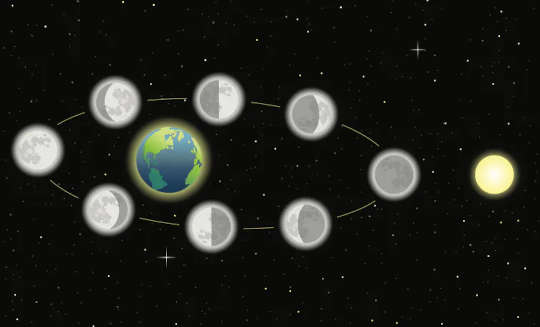 Phases of the moon. Shutterstock/Redsapphire
What’s more, the Moon’s orbit around the Earth isn’t perfectly circular – it’s a very slightly squashed ellipse. This that means sometimes the Moon is closer to the Earth than at other times. The Moon’s closest approach to Earth is called its perigee, and a full Moon at or close to perigee is called a supermoon.
More technically, it’s also known as a perigee syzygy. The opposite phenomenon – when the full Moon is furthest away from Earth in its orbit – is called an apogee syzygy or micromoon. Obviously the supermoon is not a new phenomenon, but its name is quite new – the word doesn’t appear before the 1970s.
Since the Moon is so big and bright compared to other objects in the night sky, it’s not hard to see on a clear night. To see the supermoon, the issues are working out when it rises and sets.
In the UK, the Moon rises in the east just before 7.30pm on Monday April 26 and sets in the west just after 6.00am on Tuesday April 27. It’ll be low in the sky, so try to get to a high place like a hill to see the supermoon.
If you don’t mind staying up late or getting up very early, look south around 4.40am. The Moon, Jupiter and Saturn will all be low in the sky and visible to the naked eye – a treat for early birds or night owls.
The moon illusion
There’s one catch to all this supermoon business. The Moon doesn’t actually look that much bigger in the sky compared to a normal full Moon. But it sometimes looks bigger when it’s closer to the horizon. Why is this, when its size in the sky doesn’t change very much when it orbits closer to Earth?
This is known as the Moon illusion, and it really is an illusion. If you cover the Moon with your thumb, you’ll always be able to block it out, whether it looks tiny high up in the sky or whether it looks huge closer to the horizon.
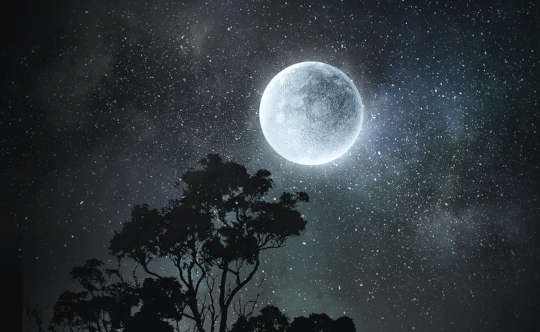
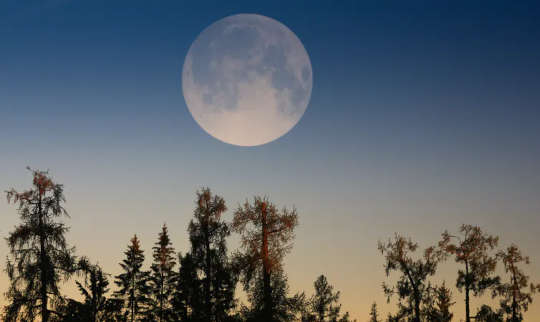 The moon appears bigger when it’s near the horizon. Shutterstock/Paramonov Alexander
People have known about this optical illusion for thousands of years, but we still don’t completely understand how or why it comes about.
We do know it’s a psychological illusion, and probably at least partly due to the brain thinking that objects near the horizon must be closer to us. There are dozens of competing explanations, and most of them are to do with how our brains process information.
So although Monday’s supermoon might not objectively look much bigger in the sky, being low on the horizon could subjectively make it look much bigger to us anyway. Whatever the cause of the Moon illusion or the size of the Moon in the sky, here’s hoping for clear skies.
About The About
Osnat Katz, PhD Candidate in Space History, UCL
Further Reading
-
The Book of the Moon: A Guide to Our Closest Neighbor
This accessible guide explains the Moon’s formation, surface, orbit and changing appearance while also examining its influence on human culture. It provides useful context for understanding lunar phases, full moons and the science behind our observations from Earth.
Amazon: https://www.amazon.com/exec/obidos/ASIN/1419738496/innerselfcom
-
The Moon Book (New & Updated Edition)
This illustrated introduction clearly explains the Moon’s orbit, phases, eclipses and relationship with Earth. Its straightforward presentation makes concepts such as reflected sunlight and the repeating lunar cycle easy to visualize.
Amazon: https://www.amazon.com/exec/obidos/ASIN/082344323X/innerselfcom
-
The Moon: From Imagination to Exploration
This richly illustrated volume combines lunar science with the history of humanity’s fascination with the Moon. It examines lunar phases and motions alongside the Moon’s enduring place in mythology, art, literature and space exploration.
Amazon: https://www.amazon.com/exec/obidos/ASIN/0593966708/innerselfcom
This article is republished from The Conversation under a Creative Commons license. Read the original article.
Article Recap
The supermoon on April 26 presents a chance to see the Moon at its closest point to Earth, though it may not appear significantly larger than usual. Observers should plan ahead for optimal viewing conditions.
#InnerSelfcom #Supermoon #MoonPhases #Perigee #OpticalIllusion #Astronomy