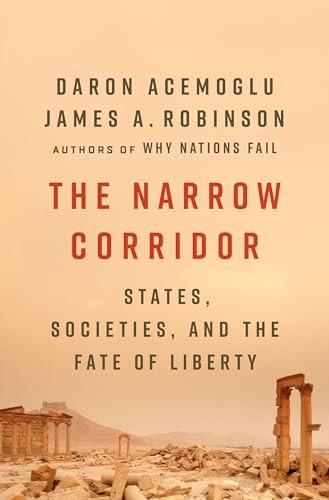
# Understanding Liberty's Precarious Path: How Societies Balance Power and Freedom
Liberty is neither guaranteed nor inevitable. This exploration of freedom's delicate foundation reveals one of the most crucial lessons for our time: the conditions that allow societies to flourish are far more fragile than we typically imagine, and understanding these conditions is essential for anyone concerned with personal freedom, social justice, and the future of democratic societies.
Most people assume that freedom is a natural state of human existence, or that once achieved, it remains secure. This work challenges that assumption fundamentally. Through extensive historical analysis spanning continents and centuries, readers discover that liberty exists in what might be called a narrow corridor, requiring constant balance between two opposing forces that seem paradoxical: societies need strong institutions to protect freedom, yet those same institutions can easily become instruments of oppression. This tension defines the entire human experience with governance and autonomy.
The central insight emerging from this investigation is that sustainable liberty requires a specific configuration of power. On one side stands state capacity, the institutional ability to enforce laws, maintain order, and provide public goods. Without sufficient state capacity, societies descend into chaos and become vulnerable to warlords, criminal organizations, and powerful private actors who exploit vulnerable populations. Yet excessive state capacity without checks leads directly to tyranny. On the other side stands societal power, the collective ability of citizens to organize, resist, and hold institutions accountable. When societies are fragmented or lack the organizational capacity to mobilize, citizens become powerless regardless of formal rights. The narrow corridor exists precisely where these two forces balance, each restraining the other.
Readers will discover concrete historical examples demonstrating how this balance emerges and collapses. The book traces the political evolution of multiple societies, showing how some managed to navigate toward greater liberty while others fell into despotism or chaos. These narratives reveal patterns that transcend geography and historical period, suggesting universal principles about power, freedom, and social organization. Understanding these patterns provides frameworks for recognizing warning signs in contemporary politics and society.
What makes this particularly relevant for those interested in social consciousness is the recognition that personal freedom cannot be separated from collective structures. Individual liberty depends not on personal virtue or individual effort alone, but on the social and political systems within which individuals operate. This perspective invites readers to think beyond personal agency toward systemic change. Someone genuinely committed to freedom must engage with questions of institutional design, power distribution, and civic participation at the social level.
The implications for contemporary society are substantial. Many democracies today face creeping threats that don't always announce themselves as such. Readers will gain the ability to recognize how gradual erosion of checks on power, polarization that fragments society, or the weakening of civic institutions can narrower the corridor within which liberty exists. The work also illuminates why simple solutions rarely work in politics: proposals that strengthen institutions without maintaining societal power lead to oppression, while demands for freedom without adequate institutions lead to disorder.
For those seeking genuine transformation and deeper understanding of social systems, this exploration offers intellectual tools to comprehend how freedom functions in practice rather than in theory. It demonstrates that building and maintaining free societies requires constant attention, participation, and vigilance. It challenges the comfortable notion that freedom, once established, takes care of itself.
This understanding matters profoundly because it connects personal interest in freedom with civic responsibility. Recognizing that liberty exists only in a narrow corridor maintained through balance explains why active participation in democracy, support for robust institutions with meaningful checks, and maintenance of a cohesive yet independent society matter so fundamentally to anyone who values freedom. The stakes of understanding these dynamics extend far beyond academic interest into the practical reality of how free and flourishing societies actually function.