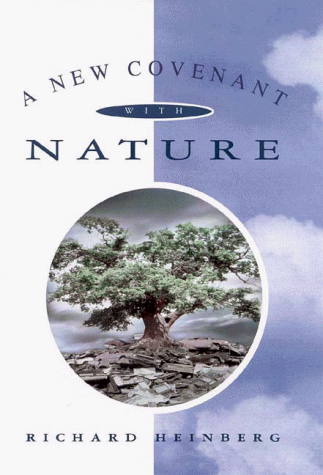











Humanity stands at a critical crossroads in its relationship with the Earth. For centuries, Western civilization has operated under an assumption of separation—the belief that humans exist apart from and above the natural world, entitled to extract its resources without reciprocal responsibility. This foundational worldview has shaped our economics, our spirituality, and our daily behaviors in ways most of us rarely examine. Yet mounting environmental crises and a growing sense of spiritual emptiness suggest that this paradigm is failing us on every level.
What if we could fundamentally reimagine our relationship with nature? What if the path forward requires not revolutionary action alone, but a profound shift in consciousness and understanding? This exploration invites you to consider how our personal transformation and planetary healing are intrinsically connected, and how adopting a new framework for relating to the living world can restore balance to both our inner lives and our outer environment.
At the heart of this inquiry is a simple yet revolutionary concept: we must move beyond the old covenant—the implicit agreement that nature exists for human consumption—toward a new one based on mutuality, respect, and genuine partnership. This shift demands that we examine our deepest assumptions about progress, wealth, and what it truly means to live a fulfilling life.
The exploration begins by tracing how our current relationship with nature developed. Western industrial civilization inherited a worldview that positioned humanity as the rational mind dominating an inert, mechanical universe. This perspective allowed for unprecedented technological advancement but at a devastating cost: the erosion of our sense of belonging within the larger web of life. We became consumers rather than participants, masters rather than members of the community of living beings. This separation created the psychological and spiritual emptiness many of us experience today, even amid material abundance.
Understanding this history is crucial because it reveals that our environmental crisis is ultimately a spiritual and philosophical crisis. We cannot solve our ecological problems using the same consciousness that created them. True transformation requires reimagining ourselves as integral parts of nature rather than external observers or exploiters. It means recognizing that what we do to the Earth, we do to ourselves, and that healing our relationship with nature is inseparable from healing ourselves.
Throughout this journey, readers will discover how indigenous and traditional cultures have maintained healthier relationships with the natural world—not because they lacked technology, but because their spiritual frameworks emphasized interconnection and reciprocal responsibility. These worldviews offer profound lessons for our time, suggesting that living in harmony isn't a primitive step backward but rather a sophisticated understanding that humanity's wellbeing depends utterly on the wellbeing of the systems that sustain us.
The practical implications of adopting a new covenant are far-reaching and deeply personal. When we begin to see ourselves as part of nature rather than separate from it, our choices transform. How we eat, what we consume, how we spend our time, and what we consider success all shift. This isn't about guilt or deprivation but about awakening to a richer, more authentic way of being that aligns with both ecological reality and our deepest human needs for meaning and connection.
This perspective also challenges us to reconsider progress itself. What does genuine advancement look like if measured not by consumption and GDP but by the quality of our relationships—with each other, with other species, and with the living Earth? How would our cities, our economies, and our lifestyles look if designed to enhance rather than diminish the natural systems we depend upon?
For those on a path of personal growth and spiritual awakening, this material offers profound insight. It demonstrates that individual transformation and collective healing are two sides of the same coin. As you shift your consciousness to recognize your belonging within nature, you become part of the solution to our greatest challenges. You discover that living with greater harmony with the natural world isn't a sacrifice but rather a return to a more authentic, peaceful, and meaningful existence.