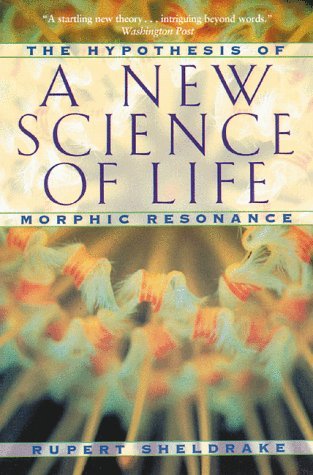













Discover a groundbreaking exploration into the hidden organizing principles that govern all living systems, from the smallest organisms to the largest ecosystems. This landmark work challenges the fundamental assumptions that have shaped modern biology and science for centuries, inviting readers to reconsider what life actually is and how it organizes itself.
At its core, this exploration introduces the revolutionary concept of morphic fields—invisible patterns of organization that shape the development and behavior of living organisms. Rather than viewing life as merely the product of genetic material and random mutations, this perspective suggests that nature possesses inherent memory and organizational patterns that guide growth, development, and behavior across generations. This idea opens entirely new possibilities for understanding not just how organisms develop, but how habits form, how knowledge spreads through populations, and how we might better align ourselves with nature's deeper organizing principles.
The implications of this framework extend far beyond academic biology. For readers interested in personal growth and career development, understanding these organizing principles offers profound insights into how habits become established, how expertise develops, and how individual potential unfolds. If nature itself operates through patterns that can be learned and aligned with, then perhaps our approaches to career development, skill acquisition, and professional growth have been operating under unnecessarily limiting assumptions.
Throughout this work, readers encounter carefully documented examples from nature that seem to defy conventional explanation. From the uncanny abilities of birds to navigate migration routes they've never traveled before, to the way certain skills appear to spread through animal populations with remarkable speed, the evidence suggests something deeper than what our current scientific models can explain. These observations aren't presented as mysticism but as genuine biological phenomena that point toward a more complete understanding of how life actually works.
One particularly relevant aspect for those focused on career and personal development involves the concept of collective memory and learning. If the patterns that organisms inherit extend beyond genetic material to include acquired knowledge and behavioral patterns, then this suggests entirely new possibilities for how expertise can be cultivated and transmitted. The traditional view that each generation must learn everything from scratch gives way to a more nuanced understanding where individuals can potentially tap into accumulated patterns of knowledge and skill that exist at deeper levels of nature.
The practical applications become increasingly clear as one progresses through this investigation. Understanding morphic fields and organizing principles can transform how we approach habit formation, skill development, and career progression. Rather than fighting against nature's grain, we can learn to work with these deeper patterns. This perspective suggests that becoming more successful in our careers isn't simply about willpower or constant effort, but about aligning ourselves with the organizing principles that already exist within us and around us.
This perspective also addresses the phenomenon of what some call intuition or genius—those moments when solutions appear seemingly without effort, or when we suddenly understand complex patterns without formal instruction. From this viewpoint, such experiences represent moments when we align with the morphic patterns that already contain the knowledge we seek. This reframes career achievement not as something we must create entirely through struggle, but as something we can access through deeper alignment and attunement.
The work presents a vision of nature and life that integrates scientific rigor with recognition of mystery and deeper organizing principles. For readers seeking to understand not just how to succeed in their careers, but why certain approaches work better than others, and how to access their fuller potential, this framework provides genuine illumination. It suggests that the patterns of nature that have guided life's evolution for billions of years can also guide our individual development and professional growth.
By expanding our understanding of how life organizes itself, we simultaneously expand our understanding of how we can organize ourselves more effectively toward meaningful work and purposeful careers.