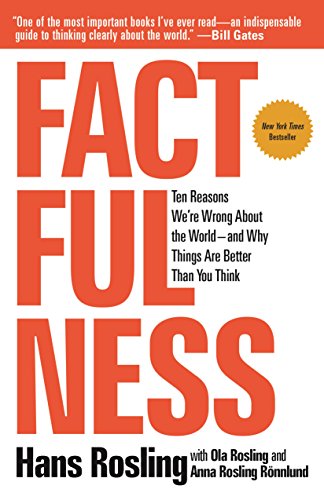




In a world overwhelmed by news headlines, social media narratives, and doom-laden predictions, most of us walk through life with a fundamentally skewed perception of reality. We believe things are worse than they actually are. We think progress is impossible. We assume the world is dividing into two opposing camps with no middle ground. These instincts feel true because they're amplified by the media, by our social circles, and by the way our brains are wired. But they're wrong—and learning why matters profoundly for your personal empowerment and peace of mind.
This transformative work offers a revolutionary approach to understanding the world as it actually is, rather than as our instincts and biases lead us to believe. At its heart lies a simple but radical premise: that most of us are dramatically wrong about the state of global affairs, and that correcting these misconceptions can fundamentally change how we see ourselves, our possibilities, and our role in creating meaningful change.
The journey begins by revealing ten instincts that consistently mislead us. These aren't character flaws or signs of stupidity. Rather, they're ancient survival mechanisms that once helped our ancestors navigate a simpler, more immediately threatening world. The negativity instinct makes us focus on bad news while ignoring improvements. The straight line instinct makes us assume trends will continue indefinitely in one direction. The fear instinct exaggerates threats. The generalization instinct leads us to lump diverse people and situations into simplistic categories. Each instinct is explored with compelling data, real-world examples, and honest acknowledgment of why these patterns persist so stubbornly in human psychology.
What makes this approach particularly valuable for personal growth is its emphasis on "factfulness"—not the cold accumulation of statistics, but a worldview grounded in genuine understanding of how things actually work. The readers discover that global child mortality has been cut in half over the past fifty years. That extreme poverty continues to decline despite what headlines suggest. That access to education is expanding, vaccines are saving millions of lives, and human life expectancy keeps rising. These aren't minor adjustments to a tragic narrative; they represent profound human achievement.
But this isn't mere optimism or denial of real problems. The work acknowledges genuine challenges: climate change, inequality, political instability, and disease remain serious concerns. The point is not to ignore these issues but to see them clearly, without the distortion that comes from our instinctive biases. This clear seeing is far more empowering than despair because it reveals where progress is actually possible and where focused effort can make real differences.
The practical framework provided helps readers develop a habit of better thinking. By learning to question your assumptions, seek out credible sources, understand the difference between mild, moderate, and serious problems, and recognize the complexity of the world, you gain tools for making better decisions about everything from personal health to civic engagement. This methodology extends far beyond statistics and into how you interpret daily experiences and navigate conversations with others.
For those on a path of personal transformation, this work offers liberation from manufactured anxiety and manufactured certainty. It provides permission to think nuancedly, to hold multiple truths simultaneously, and to maintain both hope and realistic caution. Rather than leading to passivity or complacency, accurate understanding of the world's actual trajectory inspires thoughtful action rooted in evidence rather than fear.
This is ultimately a book about intellectual humility, clear perception, and the power that comes from seeing reality clearly. In learning to separate fact from feeling, you reclaim the ability to respond to the world as it truly is—a world with genuine challenges, yes, but also remarkable progress and extraordinary human potential.