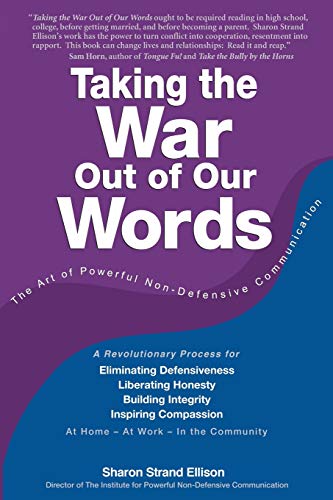

In our increasingly polarized world, where disagreements quickly escalate into hostile exchanges and meaningful dialogue seems nearly impossible, discovering a framework for genuine connection becomes not just valuable but essential. This groundbreaking work offers readers a revolutionary approach to how we communicate when tensions run high and perspectives clash. The central premise challenges everything many of us have been taught about winning arguments and defending our positions.
The core insight revolves around recognizing that most of our communication patterns, especially during conflict, are rooted in what might be called a "war mentality." We approach conversations as battles to be won, with opposing views as enemies to be defeated. This adversarial stance doesn't just fail to resolve conflicts—it actively deepens them, creating cycles of defensiveness, resentment, and disconnection. The alternative presented here invites readers to step completely outside this paradigm and imagine what becomes possible when we genuinely listen to understand rather than to counter-attack.
One of the most valuable concepts explored is the distinction between statements that provoke defensiveness and those that invite authentic dialogue. Readers learn to recognize their own habitual patterns of blame, accusation, and judgment that trigger defensive responses in others. More importantly, they discover specific techniques for rephrasing these patterns into questions and statements that open doors rather than slam them shut. This isn't about superficial politeness or avoiding honest expression. Rather, it's about learning to communicate truthfully while simultaneously respecting the humanity and perspective of the other person.
The practical tools provided are immediately applicable in daily life. Whether you're navigating heated political discussions at family gatherings, trying to influence policy conversations in your community, or simply hoping to reduce conflict in your closest relationships, the concrete language strategies offered create a different pathway forward. Readers gain clarity about what they're actually trying to accomplish in conversations and how their current word choices either support or undermine those goals.
This approach is particularly crucial in our current political landscape, where tribalism, polarization, and the inability to genuinely hear opposing viewpoints threaten the fabric of democratic discourse. When we cannot communicate across differences, democracy itself becomes weakened. Conversations become monologues. Understanding transforms into suspicion. The possibility of collaborative problem-solving dissolves. By learning to distinguish between communicating with integrity and using words as weapons, readers can become agents of change in their own spheres of influence.
The book addresses how deeply we're conditioned to view disagreement as threat. This cultural conditioning creates a self-perpetuating cycle where conflict communication becomes increasingly aggressive and dismissive. Breaking this pattern requires conscious awareness and deliberate practice. The methodologies provided give readers exactly this—awareness of what drives their communication choices and practical alternatives that feel authentic rather than manipulative.
What makes this work especially relevant for conscious readers is how it connects personal transformation with social impact. When individuals change how they communicate in their own lives, this change radiates outward. Families become less contentious. Workplaces become more collaborative. Communities develop greater capacity for diverse perspectives. These individual shifts eventually contribute to broader cultural transformation around how we engage with difference and disagreement.
Perhaps most importantly, readers discover that taking the war out of our words doesn't mean becoming passive or compromising their values. Instead, it means expressing those values in ways that actually create the possibility of being heard and respected. It means engaging in communication that reflects who we truly want to be in the world and the kind of relationships and communities we actually want to create. In a time when our ability to communicate across difference will determine our collective future, this perspective offers genuine hope and practical pathways forward.